|
"The Civil War Railroad Battles..."
The Civil War Railroad Battle and History Homepage
| Civil War Railroads: Confederacy and Border States |
|
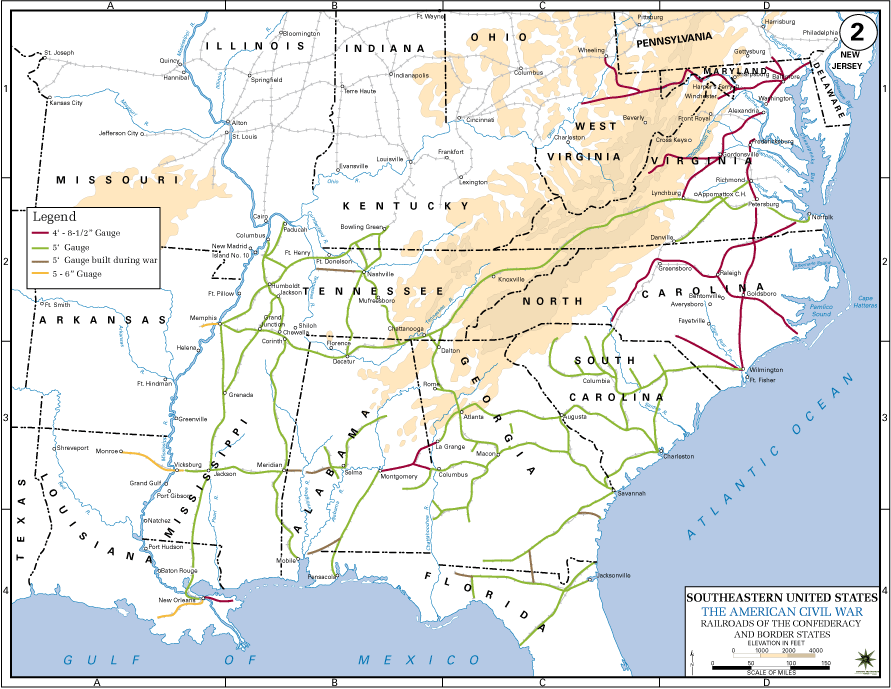
| Map of American Civil War Railroads |
American Civil War Railroads
While the above map shows the railroads of the Southeastern United
States during the American Civil War, the rail lines of the North are also highlighted. Most of the battles during
the Civil War, however, were fought in the Southern states and near railroads, making them a constant struggle and contest
of wills. Although the nation's bloodiest conflict is usually associated with its great battles, such as Gettysburg and
Shiloh, and the famous generals of Grant and Lee, the men, the unsung heroes, who guarded, built, and rebuilt the
tracks and bridges were equally important to the prosecution of the conflict.
Railroads during the American Civil War remain one of the least studied
and discussed subjects of the conflict, but the tracks and trains were so vital to the outcome of the conflict, insomuch
that merely a basic introduction of the topic shows their strategic significance.
The majority of the battles were fought in the South, the geographical
location that held only a fraction of the nation's railroads, so a single bridge often meant that a Southern army could rapidly
move troops to engage a much larger Union force. Generals Grant, Lee and many others, repeatedly made a single railroad
bridge the target of a battle or campaign. Grant, who would later become president, frequently gauged the overall
success of a battle on whether or not the bridge was still standing. Lee stated, oftentimes in 1864, that without certain
railroads along the coast, he could not continue the fight nor sustain necessary actions to resist the enemy, and that
the war would soon grind to halt. Alongside the nation's railroads was nestled another grand prize, the telegraph lines,
the cell phone of the era, and it was the only means of communication that allowed the generals the rapid response to enemy
troop movements. Unlike today, with mobile phones, internet, satellite link, and handheld radios, the only other form
of long distance communication in the 1860s was by horseback.
Because trains outright owned the monopoly on the ability to rapidly move
troops, ammunition, supplies and necessities to the front, most of the battles and even skirmishes of the Civil
War were fought near or adjacent railroads and depots. Commanders, as well as privates, understood that to destroy the
tracks or bridges was to cripple the enemy's ability to press any given battle. To blow up the railroad bridges,
tear up several miles of track, damage the trains, and to destroy the many depots was to greatly diminish the enemy's
ability to remain a viable threat and to continue the war. The capitals of the states were also considered
high priorities during the war, for many were transportation hubs and they too housed the political minds who
oversaw the state's war efforts. While it is correct that not all capitals were the most populated areas of most Southern
states, it is also true that most capitals possessed the banks, infrastructure, communications, hospitals, prisons, and war
making capabilities of the states. Capitals were also important for other reasons. When a capital was captured or
left in ruins, such as Atlanta and Columbia, the enemy also dealt a paralyzing blow to the morale of the citizens.
Because the bills needed to fund each state's railroads were decided by its legislatures, the state capitals typically
enjoyed the sounds and sights of trains rather quickly after the bills passed. So trains invariably assisted in making
the Southern capitals a grand target of every Federal incursion.
A soldier who was missing his legs was impaired and unable to
move and fight, and if an army was absent its trains, it too lacked the mobility that was necessary to transport
the equipment and logistical support to the men who were fighting in the field. It was always basic logic
to commanders of both armies: no trains meant no war.
The Civil War Railroad History Homepage covers a variety of the war's railroad
history, including battles, maps, period photos and drawings, and even diarist accounts. You are also encouraged
to use the internal search engine to further research the subject. Try typing, for instance, railroad bridge
battle or railroad battle in Virginia, or history of railroads in the Northern states.
Recommended Reading:
The Railroads of the Confederacy (400 pages) (The University of North Carolina Press: April 15, 1998). Description:
Originally published by UNC Press in 1952, The Railroads
of the Confederacy tells the story of the first use of railroads on a major scale in a major war. Robert Black presents a
complex and fascinating tale, with the railroads of the American South playing the part of tragic hero in the Civil War: at
first vigorous though immature; then overloaded, driven unmercifully, starved for iron; and eventually worn out—struggling
on to inevitable destruction in the wake of Sherman's army, carrying the Confederacy down with them. Continued below...
With maps of all the Confederate railroads and contemporary photographs
and facsimiles of such documents as railroad tickets, timetables, and soldiers' passes, the book will captivate railroad enthusiasts
as well as readers interested in the Civil War.
Recommended Reading:
Civil War Railroads: A Pictorial Story of the War Between the States, 1861-1865 (Hardcover: 192 pages) (Publisher:
Indiana University Press). Description: With more than 220 black and white photographs from the National Archives, the
Library of Congress, the Smithsonian Institution, and private collections across the country, this is the essential pictorial
guide for all those interested in the role of the Iron Horse in the American Civil War. Like all wars, the Civil War
was not all gunfire and panic. It was supply and transport, trains and trouble on the line, men in Blue and Gray fighting
against almost unbelievable odds with lumbering, woodburning engines. Continued below...
About the Author: George B. Abdill, Civil War Railroads: A Pictorial Story of the War Between the States, 1861-1865, before his death, was a railroader's writer--A working hoghead
on the Southern Pacific's Portland Division and historian of the great days of steam. His special gift was as a collector
of truly remarkable photographs illustrating the pioneering days of the railroads. And he had a special place in his heart
for military railroaders since he, himself, served with the 744th Railway Operation Battalion during World War II, running
his engine in France,
Belgium, and Germany.
He had first-hand knowledge of railroading under fire.
Recommended
Reading: A History of the American Locomotive:
Its Development, 1830-1880 (Trains) (528 pages). Description: Important and
beautifully illustrated volume chronicles the explosive growth of the American locomotive from British imports to grand ten-wheelers
of the 1870s. Over 240 vintage photographs, drawings, and diagrams tell the exciting tale. Includes
comprehensive introduction, appendices and index. Continued below...
Superb and
scholarly effort from Mr. White is readable and laudable, and he offers to us enormous access to the best pictures.
Recommended
Reading:
Confederate Industry: Manufacturers And Quartermasters in the Civil War (412 pages) (University Press of Mississippi:
September 2005). Description: For those with an interest in the Civil War, this
book gives new insight into the efforts of the Confederacy to keep its armies in the field during four years of Union onslaughts.
Harold Wilson, an English professor at Old Dominion
University, looks largely at the textile industry but also focuses on
armaments and other production. Continued below...
He also discusses the Confederacy's efforts to supply itself from Europe with blockade-running ships,
and the efforts of Northern armies - especially under Sherman
- to destroy the Confederacy's industrial base. He examines the rise of Southern industry in the decades after the war.
This is a solid, well-researched book that covers an important
area of Civil War history in unprecedented depth.
Recommended
Reading: Stealing the General: The Great Locomotive
Chase and the First Medal of Honor. Description: "The Great Locomotive Chase has been the stuff
of legend and the darling of Hollywood. Now we have a solid
history of the Andrews Raid. Russell S. Bonds’ stirring account makes clear why the raid failed and what happened to
the raiders."—James M. McPherson, author of Battle Cry of Freedom, winner of the Pulitzer Prize. Continued below...
On April 12, 1862 -- one year
to the day after Confederate guns opened on Fort Sumter -- a tall, mysterious smuggler and self-appointed Union spy named
James J. Andrews and nineteen infantry volunteers infiltrated north Georgia and stole a steam engine referred to as the General. Racing northward at speeds approaching sixty miles an hour, cutting telegraph
lines and destroying track along the way, Andrews planned to open East Tennessee to the Union army, cutting off men and materiel
from the Confederate forces in Virginia. If they succeeded, Andrews and his raiders could change the course of the war. But
the General’s young conductor, William A. Fuller, chased the stolen train first on foot, then by handcar, and finally
aboard another engine, the Texas. He pursued the General until, running out of wood and water, Andrews and his men
abandoned the doomed locomotive, ending the adventure that would soon be famous as The Great Locomotive Chase, but not the
ordeal of the soldiers involved. In the days that followed, the "engine thieves" were hunted down and captured. Eight were
tried and executed as spies, including Andrews. Eight others made a daring escape to freedom, including two assisted by a
network of slaves and Union sympathizers. For their actions, before a personal audience with President Abraham Lincoln, six
of the raiders became the first men in American history to be awarded the Medal of Honor -- the nation's highest decoration
for gallantry. Americans north and south, both at the time and ever since, have been astounded and fascinated by this daring
raid. Until now, there has not been a complete history of the entire episode and the fates of all those involved. Based on
eyewitness accounts, as well as correspondence, diaries, military records, newspaper reports, deposition testimony and other
primary sources, Stealing the General: The Great Locomotive Chase and the First Medal of Honor by Russell S. Bonds is a blend
of meticulous research and compelling narrative that is destined to become the definitive history of "the boldest adventure
of the war."
Recommended
Viewing: American Experience - Transcontinental Railroad
(2003) (PBS) (120 minutes). Description: Go behind-the-scenes of one of the greatest engineering feats of
the 19th century: the building of a transcontinental railroad across the United
States. Completed in only six years by unscrupulous entrepreneurs, brilliant engineers, and
legions of dedicated workers, the Transcontinental Railroad left a horde of displaced, broken Native Americans in its wake.
See how the railroad helped shape the politics and culture of mid-19th century
America. Reader's Review: This DVD is amazing. From the visionaries and engineers,
to the politicians and Railroad companies - mostly in it for the money - to the workers, ex-soldiers and Chinese, this
DVD covers the building of the Transcontinental Railroad very thoroughly and doesn't sugar coat the greed and self-seeking
of some. It includes the bittersweet dialogue via letters of one Railroad supervisor and his wife (living) in Ohio. It makes
for a welcome addition for high school students and above, as well as college and local libraries. I absolutely loved
the maps that showed each railroad as it was being built. This finely produced DVD also includes a Teacher's
Guide in Adobe PDF format.
Recommended Viewing: The Great Locomotive
Chase (1956) (DVD), Fess Parker (Actor), Jeffrey Hunter (Actor), Francis D. Lyon (Director) (Walt Disney
Video). Amazon.com: Disney's The Great Locomotive Chase relates a true Civil War story about the "Andrews
Raiders," a team of 22 Union spies. In 1862 they snatched a train out from under the normally watchful eyes of Confederate
troops based near Atlanta in a daredevil attempt to wreck the track and destroy several bridges of the Western &
Atlantic Railroad. It was a high-stakes operation with a huge payoff. If they succeeded, they would effectively win the war;
if they were caught, they were sure to be hanged. Continued below...
This 1956 feature shores up the suspense of the scheme masterfully. We watch,
transfixed, as the relentless Confederate train conductor, William Fuller (played by the all-business Jeffrey Hunter) roars
through a bevy of Southern stations hot on the heels of his hijacked locomotive. Will James Andrews (Fess Parker*), leader
of the Raiders, outrun him? History buffs won't need to keep watching for long, but they'll want to anyway--the portrayal
of the Raiders' gumption and against-all-odds heroics pushes the basest, most human of audience buttons. It's not that The
Great Locomotive Chase is a simple but well-done film about good vs. evil. Instead, it explores both sides' motives and
draws gentle conclusions about honor, and it does so at an invigoratingly high clip. In that way, it's a movie worth sharing
with kids 8 and older--there's no blood and only a sprinkling of violence here, but as with all war stories, tragedy plays
a prominent role.
* The actor Fess Parker (born on August 16, 1924) died on March
18, 2010 (aged 85). Parker had served in the U.S. military, was an actor, and a successful businessman. Parker
was a quintessential westerner, a tall, rugged, Texas-born athlete turned actor, famous for his portrayals of two frontiersmen,
Davy Crockett (King of the Wild Frontier) and Daniel Boone (159 episodes). During his career, Parker also portrayed sheriffs,
cowboys and ranchers. He greatly appreciated the commercial rewards of these two title roles, Davy Crockett and Daniel Boone, and
went on to become a successful businessman. (Source: guardian.co.uk)
Civil War Railroad History Battles Map, Confederate Railroads Trains Details Battle Bridge
Bridges Length Lengths Union Railroads Miles Distance, American Civil War Railroad Raids Raid Significance
|
