|
President Andrew Johnson
| 17th President Andrew Johnson |
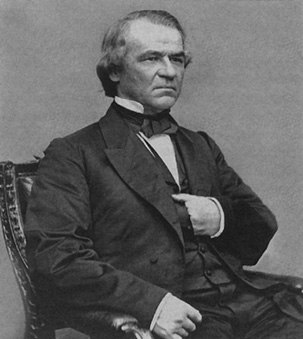
|
| President Andrew Johnson |
Seventeenth President of the United States 1865-1869
Born: December
29, 1808, in Raleigh, North Carolina
Died: July 31, 1875, in Carter's Station, Tennessee
Married to Eliza McCardle
Johnson
With the assassination of President Abraham Lincoln, the Presidency fell upon an old-fashioned southern Jacksonian Democrat
of pronounced states' rights views. Although an honest and honorable man, Andrew Johnson was one of the most unfortunate of
Presidents. Arrayed against him were the Radical Republicans in Congress, brilliantly led and ruthless in their tactics.
Andrew Johnson was a man with whom nearly every American can relate,
from the poorest to the wealthiest. With unyielding determination, he rose from dire circumstances to the nation's most prestigious
office without having attended a single day of school. Andrew Johnson was a Democrat; Abraham Lincoln was a Republican. For
the first time in 1864, the National Union Party existed as a structured, nationwide party for the Lincoln and Johnson ticket.
It was an attempt to unify Republicans and pro-war Democrats. During
secession, Johnson was the only Southern Senator that refused to resign.
Andrew Johnson was born in Raleigh, North Carolina,
on December 29, 1808, to Jacob and Mary ("Polly") Johnson. In 1811 his father saved some acquaintances from drowning in a
river, but the effort weakened him irrevocably. He died in January 1812, when Andrew was three years old.
Jacob Johnson had been a respected man, but one of meager means. With his
death, his wife and two sons were left destitute. Polly Johnson apprenticed her sons, William and Andrew, to a local tailor.
They ran away in 1824 and there was $10.00 reward posted for their return. In 1826 Andrew arrived in Greeneville, Tennessee, and opened a tailor shop and participated in debates at the local academy.
Andrew married in 1827; Mordecai Lincoln, a relative of Abraham Lincoln's, performed the marriage ceremony for Andrew
Johnson and Eliza McCardle.
He was a capable tailor, and his flourishing shop became a gathering
place for political discussion and debate. By 1829, Johnson was elected alderman of the town of Greeneville. He had embarked on his political career and would hold nearly every elective
office between alderman and president.
Entering politics, he became an adept stump speaker, championing the common
man and vilifying the plantation aristocracy. As a Member of the House of Representatives and the Senate in the 1840s and
1850s, he advocated a homestead bill (see Homestead Act) to provide a free farm for the poor man.
Andrew Johnson was injured in a train wreck in 1857. Consequently, his
right elbow was virtually immobile and he often used a signature stamp for documents.
| President Andrew Johnson |
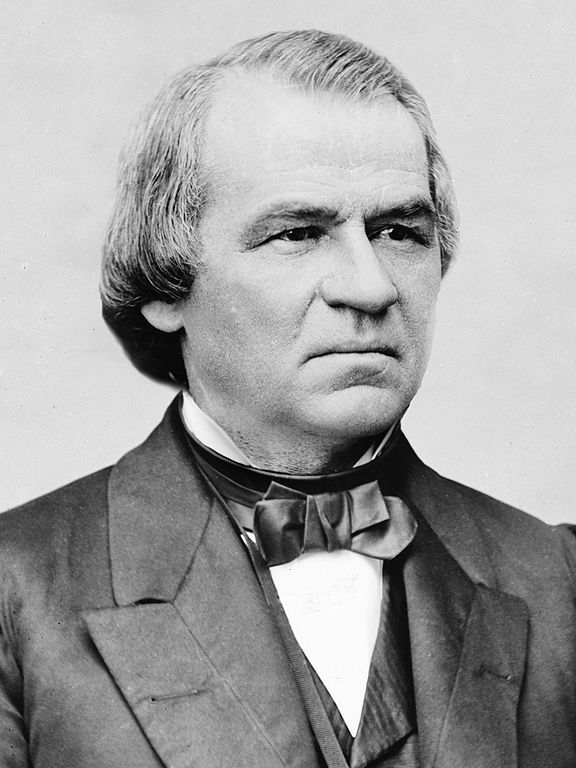
|
| President Andrew Johnson |
During the secession crisis, Johnson remained in the United States Senate even when Tennessee seceded, which
made him a hero in the North and a traitor in the eyes of most Southerners. In 1862, President Lincoln appointed him Military
Governor of Tennessee, and Johnson used the state as a laboratory for reconstruction. In 1864 the Republicans, contending
that their National Union Party was for all loyal men, nominated Johnson, a Southerner and a Democrat, for Vice President.
After Lincoln's death, President Johnson proceeded to reconstruct the former Confederate States while Congress was not in session in 1865. He
pardoned all who would take an oath of allegiance, but required leaders and men of wealth to obtain special Presidential pardons.
By the time Congress met in December 1865, most southern states were reconstructed,
slavery was being abolished, but "black codes" to regulate the freedmen were beginning to appear.
Radical Republicans in Congress moved vigorously to change Johnson's program.
They gained the support of northerners who were dismayed to see Southerners keeping many prewar leaders and imposing many
prewar restrictions upon Negroes.
The Radicals' first step was to refuse to seat any Senator or Representative
from the old Confederacy. Next, they passed measures dealing with the former slaves. Johnson vetoed the legislation. The Radicals
mustered enough votes in Congress to pass legislation over his veto--the first time that Congress had overridden a President
on an important bill. They passed the Civil Rights Act of 1866, which established Negroes as American citizens and forbade discrimination against
them.
A few months later, Congress submitted to the states the Fourteenth Amendment, which specified that no state should "deprive any person of life, liberty,
or property, without due process of law."
All the former Confederate States, except Tennessee, refused to ratify the
amendment; furthermore, there were two bloody race riots in the South. Speaking in the Mid-West, Johnson faced hostile audiences.
The Radical Republicans won an overwhelming victory in Congressional elections that fall.
In March 1867, the Radicals effected their own plan of Reconstruction, again
placing southern states under military rule. They passed laws placing restrictions upon the President. When Johnson allegedly
violated one of these, the Tenure of Office Act, by dismissing Secretary of War Edwin M. Stanton, the House voted eleven articles of impeachment against him. He was tried by the Senate in the spring of 1868 and acquitted
by one vote.
In 1867, during Andrew Johnson's administration, Alaska was purchased from
Russia for $7,200,000. Secretary of State William Seward was instrumental in the purchase. People who thought the investment
a bad idea called the purchase "Seward's Folly."
In 1875, Tennessee returned Johnson to the Senate. He died a few months later
and was buried in Greeneville, Tennessee, with the Constitution resting under his head and with his body wrapped in the American flag.
| Andrew Johnson |
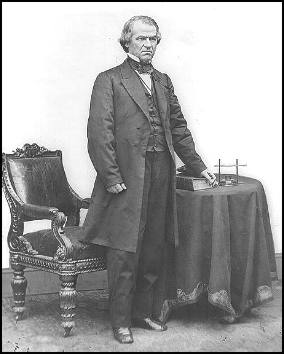
|
| President Andrew Johnson |
A constant champion
of the common man and defender of the Constitution, Johnson had faced opposition and impeachment; he is remembered as the
"Constitutional President."
(Sources listed at bottom of page.)
Recommended
Reading: Andrew Johnson : A Biography (Signature Series) (Hardcover). Description: On April 14, 1865, just as the American
Civil War came to an end, Abraham Lincoln was assassinated by a Confederate actor. The next morning Andrew Johnson was suddenly
elevated to the position of president of the United States at a time when the nation was still
suffering from the effects of war. This biography explores the enigma of the homeless and uneducated tailor whose spectacular
rise to power ended in disgrace. It relates how his term in office undermined the process of reconstruction and left a legacy
of racism. Over a century later, Johnson remains the only president of the United States to have been
impeached. The author explores Johnson's undeniable skills as a political leader and his stubborn attachment to a mythical
view of the America
of his youth, which proved to be his undoing. Continued below…
From Library
Journal: Known for his Carl Schurz: A Biography (LJ 2/15/82), Trefousse delivers the first Johnson study in years, a definitive
assessment of his career and presidency. Johnson's papers and other sources reveal his fatal idealization of the agrarian
utopia, his fierce advocacy of strict Constitutional constructionism, and his imprudent insistence upon the Republican Party’s
adoption of his views on race. Trefousse demonstrates that Johnson, because of his upbringing, was out of step with the great
changes emerging at the end of the Civil War. His stubborn attachment to his increasingly archaic views was responsible for
his political and military success, but also for his impeachment. A brilliant, compassionate portrait of a dynamic era of
social change and national healing, and of the tragic failure of an American leader. Not to be missed. --Susan E. Parker,
Harvard Law Sch. Library. About the Author: Hans L. Trefousse is professor of history at Brooklyn
College and the Graduate Center of the City University of New York. His other books
include The Radical Republicans, a path breaking history of Reconstruction.
Recommended
Reading: Andrew Johnson: The American Presidents Series: The 17th President, 1865-1869 (Hardcover). Description: The unwanted president who ran afoul
of Congress over Reconstruction and was nearly removed from office. Andrew Johnson never expected to be president, but just
six weeks after becoming Abraham Lincoln’s vice president, the events at Ford’s Theatre thrust him into the nation’s
highest office. Continued below…
Johnson faced
a nearly impossible task—to succeed America’s
greatest chief executive, to bind the nation’s wounds after the Civil War, and to work with a Congress controlled by
the so-called Radical Republicans. Annette Gordon-Reed, one of America’s leading historians
of slavery, shows how ill-suited Johnson was for this daunting task. His vision of reconciliation abandoned the millions of
former slaves (for whom he felt undisguised contempt) and antagonized congressional leaders, who tried to limit his powers
and eventually impeached him. The climax of Johnson’s presidency was his trial in the Senate and his acquittal by a
single vote, which Gordon-Reed recounts with drama and palpable tension. Despite his victory, Johnson’s term in office
was a crucial missed opportunity; he failed the country at a pivotal moment, leaving America
with problems that we are still trying to solve. About the Author: Annette Gordon-Reed is a professor of law at New York Law School,
where she has taught since 1992. She is the author of the celebrated Thomas Jefferson and Sally Hemings: An American Controversy,
co-author with Vernon Jordan
of Vernon Can Read!, and editor of Race on Trial: Law and Justice in American History. She lives in New York City.
Recommended
Reading: Impeached: The Trial of President Andrew Johnson and the Fight for
Lincoln's
Legacy. Description: From School Library Journal: One of our more controversial political figures,
Andrew Johnson came closer than any other U.S. President to being removed from office through impeachment. This study by Stewart
(Summer of 1787: The Men Who Invented the Constitution), a Washington lawyer who has argued against impeachment in Senate proceedings,
examines Johnson's rocky relationship with the post-Civil War radical Republicans. Continued below…
He breaks with
those historians who have suggested that Johnson followed what would have been Lincoln's
path to reconstruct the South, as he discusses the complex impeachment proceedings against Johnson and the effectiveness of
the impeachment process in calming political tensions, if not in removing Presidents from office. Readers who wish to broaden
their understanding of Lincoln in this anniversary year will do well to select this well-researched work even if their collection
already includes such examinations as Howard Mean's narrower The Avenger Takes His Place: Andrew Johnson and the 45 Days That
Changed the Nation.—Theresa McDevitt, Indiana Univ. of Pennsylvania Library. From Publishers Weekly: Fresh from his
masterful The Summer of 1787, Stewart takes on one of the seamiest events in American history: the vengeful impeachment of
Lincoln's
successor as president; the Senate failed to convict Andrew Johnson by a single vote. At issue was the continuation of Lincoln's
plans to reintegrate the South into the union after the Civil War. But also at stake, as always, was party politics. Stewart
takes readers through a tangled web of motives and maneuverings in lively, unadorned prose. He's skilled at characterizing
his large cast of characters and, as a lawyer, has a practiced nose for skullduggery, of which there was much. Corruption
deeply marred the entire impeachment effort. Justifiably, Stewart holds his nose about most of the people involved and admires
few of them. As he sums it up, in 1868 none of the country's leaders was great, a few were good, all were angry, and far too
many were despicable. Stewart offers little analysis and advances no new ideas about what he relates, but he tells the story
as well as it's ever been told. Black and white photos.
Recommended
Reading: The Presidency of Andrew Johnson (American Presidency Series) (Hardcover). Description: Andrew Johnson, who became president
after the assassination of Lincoln,
oversaw the most crucial and dramatic phase of Reconstruction. Historians have therefore tended to concentrate, to the exclusion
of practically everything else, upon Johnson's key role in that titanic event. Although his volume focuses closely on Johnson's
handling of Reconstruction, it also examines other important aspects of his administration, notably his foreign, economic,
and Indian policies. As one of the few historians to do this, the author provides a broader and more balanced picture of Johnson's
presidency than has been previously available. Continued below…
Johnson has
always been an enigma: much is known about what he did, little about why he did it. He wrote few letters, kept no diary, and
rarely confided in anyone. Most historians either admire or despise him, depending on whether they consider his Reconstruction
policies right or wrong. Castel achieves an objective reassessment of Johnson and his presidential actions by examining him
primarily in terms of his effectiveness in using power and by not judging him--as most other scholars have--on moralistic
or ideological grounds. The book begins with an overview of America at the end of the Civil War and a description
of Johnson's political career prior to 1865. Castel recounts the drama of Johnson's sudden inheritance of the presidency upon
Lincoln's
death and then examines how Johnson organized and operated his administration. Johnson's formulation of a Reconstruction policy
for the defeated South comes under special scrutiny; Castel evaluates Johnson's motives for that policy, its implementation,
and its reception in both North and South. He descries and analyzes Johnson's quarrel with the Republican dominated Congress
over Reconstruction, the triumph of the Republicans in the election of 1866, the president's frustrated attempt to remove
Secretary of War Edwin M. Stanton from office, his bitter dispute with General Ulysses S. Grant, and his impeachment by Congress.
Johnson's impeachment trial is covered in detail; Castel explains how it was that Johnson escaped conviction and removal from
office by the narrowest possible margin. The book concludes with a discussion of Johnson's place in history as judged by scholars
during the past one hundred years. This study sheds light on the nation's problems during the chaotic period between 1865
and 1869 and contributes a great deal to a much improved understanding of the seventeenth president. This book is part of
the American Presidency Series.
Recommended
Viewing: The History Channel
Presents The Presidents (DVD: 6 Hours). Description: THE PRESIDENTS is an unprecedented eight-part survey of the
personal lives and legacies of the remarkable men who have presided over the Oval Office. From George Washington to George
W. Bush, THE PRESIDENTS gathers together vivid snapshots of all 43 Commanders in Chief who have guidedAmerica throughout its
history--their powerful personalities, weaknesses, and major achievements or historical insignificance. Based on the book
To the Best of My Ability, edited by Pulitzer Prize-winner James McPherson, THE PRESIDENTS features rare and unseen photographs
and footage, unexpected insight and trivia from journalists, scholars, and politicians such as Walter Cronkite, David Brinkley,
Wesley Clark, Bob Dole, and former President Jimmy Carter. Continued below...
Viewed
within the changing contexts of each administration, the Presidency has never seemed more compelling and human. Narrated by
Edward Herrmann ("The Aviator"), this three-DVD set is a proud addition to the award-winning documentary tradition of THE
HISTORY CHANNEL®. DVD Features: Feature-length Bonus Program "All The Presidents' Wives"; Timeline of U.S. Presidents;
Interactive Menus; Scene Selection, and more!
Recommended
Reading: Abraham Lincoln (The American Presidents Series: The 16th President, 1861-1865) (Hardcover). Description:
America’s greatest
president, who rose to power in the country’s greatest hour of need and whose vision saw the United States
through the Civil War. Abraham Lincoln towers above the others who have held the office of president—the icon of greatness,
the pillar of strength whose words bound up the nation’s wounds. His presidency is the hinge on which American history
pivots, the time when the young republic collapsed of its own contradictions and a new birth of freedom, sanctified by blood,
created the United States
we know today. His story has been told many times, but never by a man who himself sought the office of president and contemplated
the awesome responsibilities that come with it. Continued below…
George S. McGovern—a
Midwesterner, former U.S.
senator, presidential candidate, veteran, and historian by training—offers his unique insight into our sixteenth president.
He shows how Lincoln
sometimes went astray, particularly in his restrictions on civil liberties, but also how he adjusted his sights and transformed
the Civil War from a political dispute to a moral crusade. McGovern’s account reminds us why we hold Lincoln in such esteem and
why he remains the standard by which all of his successors are measured. George S. McGovern represented South Dakota in the United
States Senate from 1963 to 1981 and was the Democratic nominee for president in 1972. He was a decorated bomber pilot in World
War II, after which he earned his Ph.D. in American history and government at Northwestern University.
A recipient of the Presidential Medal of Freedom, he lives in Mitchell, South Dakota.
Abraham Lincoln, who came into the presidency in the country’s greatest hour of need, towers above the others who have
held the office of president—the icon of greatness, the pillar of strength whose words bound up the nation’s wounds.
His vision saw the United
States through the Civil War. His presidency is the hinge
on which American history pivots, the time when the young republic collapsed of its own contradictions and a new birth of
freedom, sanctified by blood, created the United States we know today. His story has been
told many times, but never by a man who himself sought the office of president and contemplated the awesome responsibilities
that come with it. George S. McGovern—a Midwesterner, former U.S. senator, presidential
candidate, veteran, and historian by training—offers his unique insight into our sixteenth president. He shows how Lincoln
sometimes went astray, particularly in his restrictions on civil liberties, but also how he adjusted his sights and transformed
the Civil War from a political dispute to a moral crusade. McGovern’s account reminds us why we hold Lincoln in such esteem and
why he remains the standard by which all of his successors are measured. "The greatness and imperfections of America's
16th president, captured by a former Democratic nominee for the White House. With considerable skill and insight, McGovern
crafts a biography snappy, clear and comprehensive enough to please general readers, students and scholars alike. In eight
short chapters, six of which deal with Lincoln's presidency,
he nails the essential strengths, flaws, failures and achievements of America's most revered
leader."—Kirkus Reviews. "McGovern’s Lincoln
is a finely wrought gem. In this small volume McGovern captures Lincoln’s character and leadership strengths better than many
weighty tomes. It is a worthy addition to the brilliant American Presidents Series."—Doris Kearns Goodwin. "If you like
your biographies very short and sweet with a dash of corrective moralism, you might try George McGovern's Abraham Lincoln,
a well-timed entry in Times Books' presidents series, written by the former White House candidate."—David Waldstreicher,
The Boston
Globe. "Lincoln
is one of the few presidents to be claimed by both liberals and conservatives. This volume by the former Democratic presidential
candidate (in the American President Series from Times Books, edited by Arthur M. Schlesinger Jr. and Sean Willentz) examines
Lincoln's record from a liberal point of view, particularly his early and apparent contradictory views on slavery—his
platform made clear that his purpose was to contain slavery in the Southern states, not to abolish it. An example: In our
16th president, writes McGovern, 'We see the decency of popular government. Its role, then as now, was, as Lincoln wrote "to elevate the
condition of men . . . to afford all an unfettered start in the race of life" . . . To him, democracy was an experiment that
the world had not seen before.' Simply put, McGovern makes a convincing case that America's
first Republican president was really our first democratic president."—Allen Barra, The Star-Ledger (Newark). "The greatness and
imperfections of America's
16th president, captured by a former Democratic nominee for the White House. With considerable skill and insight, McGovern
crafts a biography snappy, clear and comprehensive enough to please general readers, students and scholars alike. In eight
short chapters, six of which deal with Lincoln's presidency,
he nails the essential strengths, flaws, failures and achievements of America's most revered leader.
Born in a Kentucky log cabin, Lincoln was a melancholic who
suffered more than his fair share of misfortune. According to McGovern, he nevertheless earned success through his ceaseless
hard work, powerful intellect and incomparable abilities as a speechwriter. Lincoln began his political career as a member
of the Whig Party. After serving in the Illinois state legislature, he won election to the U.S. Congress in 1846, but lost
support by challenging President James Polk on the origins of the Mexican War and lasted only one term. The 1854 Kansas-Nebraska
Act, sponsored by Democratic Senator Stephen Douglas, reinvigorated Lincoln's political ambitions. While he believed the Constitution did
not allow for abolition in the South, he staunchly opposed the westward expansion of slavery. With the Whig Party split, he
joined the new Republican Party in 1856 and ran against Douglas
for a Senate seat in 1858. Although he lost this race, Lincoln
gained national prominence as a result of his famous debates with Douglas.
Two years later, he won the 1860 presidential election, a victory that angered the South and brought about secession and war.
What was he like as a wartime president? In three core chapters, McGovern astutely assesses Lincoln's emergence as a commander
in chief committed to 'total war.' The author does not shy away from criticizing his subject, particularly for suspending
habeas corpus and censoring the press. Still McGovern's overall depiction is one of a complex, tolerant and extraordinary
man who simultaneously preserved the Union and transformed
the nation. Compact and commanding."—Kirkus Reviews. "Former U.S. senator McGovern—who
is also a Ph.D. historian—knows something about presidential leadership and the potential and actual abuses of power
that come especially during wartime. In this compact but convincing portrait, he assesses Lincoln's greatness in terms of
his ability to use his humble origins, empathy, keen sense of justice, uncommon skill in seeing the essence of an issue, faith
in American democracy, gifts of language, and personal self-confidence—all to become a masterly lawyer, a party leader,
commander in chief, and a heroic figure with both the vision and the practicality to realize his purposes . . . Given his
own politics. About the Author: George S. McGovern represented South Dakota in the United States Senate from 1963 to 1981 and was
the Democratic nominee for president in 1972. He was a decorated bomber pilot in World War II, after which he earned his Ph.D.
in American history and government at Northwestern
University. A recipient
of the Presidential Medal of Freedom, he lives in Mitchell,
South Dakota.
Bibliography: The White House; Andrew Johnson National Historic Site; National Park Service; Library of
Congress; American National Biography; Dictionary of American Biography; Trefousse, Hans L. Andrew Johnson:
A Biography. New York: W.W. Norton & Co., 1989; Johnson, Andrew. The Papers of Andrew Johnson. Edited by LeRoy
P. Graf, Ralph W. Haskins, and Paul H. Bergeron. 11 vols. to date. Knoxville: University of Tennessee Press, 1967; National
Archives; senate.gov; bioguide.congress.gov.
|
