|
Battle of Shiloh
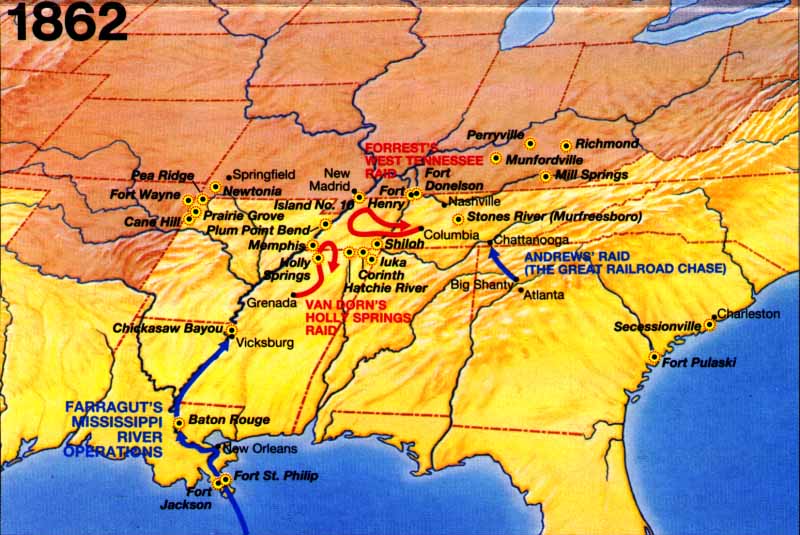
| Map of Western Theater of the Civil War in 1862 |
|
| Western Campaign in 1862 Map |
When Gen. Albert Sidney Johnston
had united his forces from Nashville with those collected under General Beauregard at Corinth--the latter including the reinforcements
from Pensacola and Mobile under General Bragg, and Polk's command from Columbus, which was evacuated--he organized his army
with Gen. G. T. Beauregard second in command, and Maj.-Gen. Braxton Bragg chief of staff and in immediate charge of the Second
corps. Maj.-Gen. Leonidas Polk commanded the First corps, Maj.-Gen. W. J. Hardee the Third, and Maj.-Gen. John C. Breckinridge
the Reserve corps.
The Tennesseans were assigned as follows: In Polk's corps, First
division, Brig.-Gen. Charles Clark commanding--the Twelfth, Thirteenth and Twenty-second regiments, and Bankhead's battery,
to the First brigade, Col. R. M. Russell; the Fourth and Fifth regiments to the Second brigade, Brig.-Gen. A. P. Stewart.
Second division, Maj.-Gen. B. F. Cheatham commanding--the Second (Knox Walker's), Fifteenth, One Hundred and Fifty-fourth
(senior), and Polk's battery, to the First brigade, Brig.-Gen. Bushrod R. Johnson; the First, Sixth and Ninth to the Second
brigade, Col. W. H. Stephens.
In Bragg's corps, the Thirty-eighth regiment was assigned
to Col. Preston Pond's brigade of Ruggles' division; the Fifty-first and Fifty-second to Brigadier-General Chalmers' brigade
of Withers' division. In Hardee's corps, Brigadier-General Cleburne's brigade included the Thirty-fifth, Twenty-third and
Twenty-fourth regiments, and Brig.-Gen. S. A. M. Wood's brigade, the Twenty-seventh, Forty-fourth and Fifty-fifth. The Reserve
corps had the Nineteenth, Twentieth, Twenty-eighth and Forty-fifth regiments, and Rutledge's battery, in the brigade of Col.
W. S. Statham, and Crew's battalion, in Col. R. P. Trabue's brigade. Forrest's cavalry was under the immediate orders of the
general commanding.
At 11 a.m. of the battle of the 6th, when Gen. Bushrod Johnson
was disabled by a painful wound, the command of the brigade devolved upon Col. Preston Smith, of the One Hundred and Fifty-fourth
Tennessee, and the command of that gallant regiment upon Lieut.-Col. Marcus J. Wright. At 2:30 p.m. of the same day, Col.
George Maney, senior officer of Stephens' brigade, assumed the command of it; and Maj. Hume R. Feild, next in rank present,
took command of the First Tennessee.
Polk's corps, with the exception of Blythe's
Mississippi,
the Eleventh Louisiana and the Thirteenth Arkansas, was composed entirely of Tennesseans. Colonel Lindsay's Mississippi regiment of cavalry reported to General Polk. This splendid regiment had been
known up to this date as Miller's battalion, Lieut.-Col. J. H. Miller commanding.
On the 3d day of April General Johnston issued an address to the troops, in which he announced, "I have put you in motion
to offer battle to the invaders of your country." Hon. Jacob Thompson, of Mississippi,
aide to General Beauregard, in his report of April 9th states that this advance was made "in consequence of the information
brought. from General Cheatham," who occupied Bethel Station and the town of Purdy
with his division.
In the attack about to be made on General Grant, General Johnston expected to beat him back to his transports and there capture
him and his forces, then cross the Tennessee river and give battle to Buell, known to be advancing to Grant's assistance.
General Johnston rapidly concentrated his troops and delivered battle in the early morning of the 6th of April. That peerless
soldier was in immediate and active command of the troops, General Beauregard being at his quarters in very feeble health,
and his presence inspired unbounded enthusiasm. The disasters at Fishing creek and Forts Henry and Donelson had subjected
him to the criticism of politicians, but the army and intelligent people of all classes gave him support and confidence. No
fault can be named in his plan of attack, and it was successful at all points.
Grant's
troops made a stout resistance, but retired slowly from the moment of the firing of the first gun by Hardee until the fall
of Johnston
at 2 o'clock p.m., when the battle of Shiloh was already won and the Federal hosts were driven
back in confusion from the field. Gen. James R. Chalmers, who occupied the advance of the Confederate army at the close of
the day, in a published letter, said: "One more resolute movement forward would have captured Grant and his whole army." That
movement was not made. The troops were withdrawn to receive an attack from the combined forces of Grant and Buell on the following
day. Another battle of Shiloh was fought, with varying success, until our forces began to
yield about noon, and at 2 p.m. received orders from General Beauregard to retire.
Tennessee was represented on all parts of the field and in all commands. Her sons sustained and promoted
the character and reputation of the State, and elevated the standard of courage, fidelity and patriotism. Their death-roll
shows that they were in the fore-front of the battle, and with a single exception there was no failure of duty. That exception
was the Fifty-second regiment of infantry, Chalmers' brigade, which was unfortunate in its field officers. General Chalmers,
in his official report, stated that the Fifty-second Tennessee, except two companies under Capts. J. A. Russell and A. N.
Wilson, who fought with the Fifth Mississippi, behaved badly.
| Western Theater Civil War Map |

|
| Shiloh Civil War Battle Map |
The sons of Tennessee, of every rank, were conspicuous for dash and
steadiness in action, and for the maintenance of regimental and company organizations under all conditions. General Beauregard,
in his report, made honorable mention of Generals Cheatham and Bushrod Johnson; and General Polk, referring to the brigades
of Johnson and Russell and their charge on Sherman's division, and to the valor of friend and foe, mentions the dangerous
wounds received by Generals Clark and Johnson, the death of the noble Col. A. K. Blythe of Mississippi (a son of Tennessee);
the wounding of gallant Capt. Marsh T. Polk, who lost a leg; and the final dislodgment of the enemy and the capture of two
batteries, one by the One Hundred and Fifty-fourth Senior Tennessee, Col. Preston Smith, the other by the Thirteenth Tennessee,
Col. A. J. Vaughan, Jr.
Polk also called attention to the "brilliant courage"
of the Fifth Tennessee, Col. C. D. Venable, and the Thirty-third Tennessee, Col. Alex. W. Campbell, and to the gallantry of
Lieut.-Col. O. F. Strahl, who, in reply to the inquiry of his intrepid brigade commander, General Stewart, "Can you take that
battery?" said, "We will try," and at the order, Forward, moved at a double-quick to within thirty paces of the enemy's guns,
halted, delivered one round, and with a yell charged the battery, capturing several prisoners and the guns; but the valorous
Fourth lost Maj. John F. Henry and Capt. John Sutherland, with 31 men killed and 150 wounded. The battery captured was composed
of heavy guns, supported by several regiments of infantry.
Of another famous
incident of the battle, General Polk reported that about 5 p.m. of the 6th, his line attacked the enemy's troops (the last
that were left upon the field) in an encampment on his right. The attack was made in front and flank. The resistance was sharp
but short, when the enemy, perceiving he was flanked and his position completely turned, hoisted his white flag and surrendered
with his command, 2,200 strong. The Federal commander's sword being delivered to Col. R. M. Russell, commanding First brigade,
it was found the forces captured were those of Brig.-Gen. B. M. Prentiss, Sixth division of Grant's army.
At 8 a.m. of the 7th General Polk ordered
Cheatham's division, reinforced by the Thirty-third and Twenty-seventh Tennessee, and Gibson's Louisiana brigade, to move "past Shiloh church to form on left of our line." "They engaged the enemy so soon as they were formed and
fought him, for four hours, one of the most desperately-contested conflicts of the battle. The enemy was driven gradually
from his position." General Cheatham declared that this conflict was "the most hotly contested I ever witnessed." He had met
fresh troops under McCook. General Polk made honorable mention of Generals Cheatham, Clark,
Stewart and Johnson, and Colonels Russell, Maney, Stephens and Preston Smith. Of General Cheatham he said: "In the operations
of this morning (the 7th), as well as the clay before, those of my troops under the immediate orders of Major-General Cheatham
bore themselves with conspicuous gallantry. One charge particularly was made under the eye of the commander-in-chief and his
staff, and drew forth expressions of the most unqualified applause."
Cheatham carried
into battle 3,801 officers and men. He lost 1,213 killed and wounded, nearly one-third of the command. Among the killed was
noble young John Campbell, acting aide; Colonel Wickliffe and Major Wel-born, Seventh Kentucky; Capts. J. B. Freeman and G.
G. Persons, and Lieut. Isaac M. Jackson, Sixth Tennessee; Adjt. Robert Thomas, Ninth Tennessee; Capt. E. M. Cheairs, One Hundred
and Fifty-fourth regiment, and others not reported. Colonel Pond, commanding brigade, in his report of the battle makes honorable
mention of Col. Robert F. Looney, Thirty-eighth Tennessee. Colonel Looney in his own report states that he was ordered by
General Polk to charge a battery and camp on the morning of the 6th, and "I ordered the charge, which was promptly and successfully
executed as to the camp and battery, and I suppose at least 1,000 prisoners."
Col.
D. H. Cummings, Nineteenth Tennessee, Reserve corps, had been on detached service, with the First Tennessee, under orders
from General Johnston; at 2:30 p.m. of the 6th, he reported through his adjutant, Melville Doak, to General Cheatham, and
was now advanced, with the First and Ninth Tennessee under Colonel Maney, to a final attack on the only position held by the
enemy in Cheatham's front. The enemy was routed and fled the field. Lieut.-Col. J. H. Miller, with his battalion of Mississippi cavalry, was ordered by Cheatham to fall upon him in his
flight. This resulted in the capture of Ross' Michigan battery
of six guns, with officers and men. Colonel Cummings made no report, neither did Colonel Statham, commanding brigade, but
it is known that the Nineteenth was an active participant in all of the stirring events of the two days' battle, and bore
an honorable part in the movement resulting in the capture of Prentiss' division. It lost 25 per cent.; among the wounded
being Colonel Cummings and Major Fulkerson, and in the list of killed, Capts. Z. T. Willett and Thomas H. Walker.
Hardee, who opened the battle of the 6th at dawn of day, stated in his official report that in the first assault made by Cleburne, "Colonel Bate, Second Tennessee, fell severely wounded while
bravely leading his regiment." Colonel Bate was afterward brigadier and major-general. At the same time, gallant Maj. W. R.
Doak and Capts. Joseph P. Tyree and Humphrey Bate, and Lieuts. E. R. Cryer, J. A. Akers and G. C. Fugitt, of the same regiment,
were killed.
In the attack on the left center of General Hardee's line, "Brigadier-General
Wood charged a battery on a gentle acclivity and captured six guns, with the Second (Bate's) and Twenty-seventh Tennessee
and Sixteenth Alabama. In this attack Col. Christopher H. Williams of the Twenty-seventh Tennessee was killed. The army and
the Confederacy sustained a severe loss in the death of this gallant officer." General Wood, referring in his report to that
noble man and to the same charge, says: "Colonel Williams, of the Twenty-seventh Tennessee, a modest, unassuming gentleman
and Christian soldier, faithful in every duty, devoted to his country, his native State, and the cause of liberty, fell and
died. Lieutenant-Colonel Brown of the same regiment was seriously wounded; Captain Hearn and Lieutenant Henry were killed."
Maj. Samuel T. Love of the Twenty-seventh, serving under Cheatham on the 7th, was killed in a charge on the enemy.
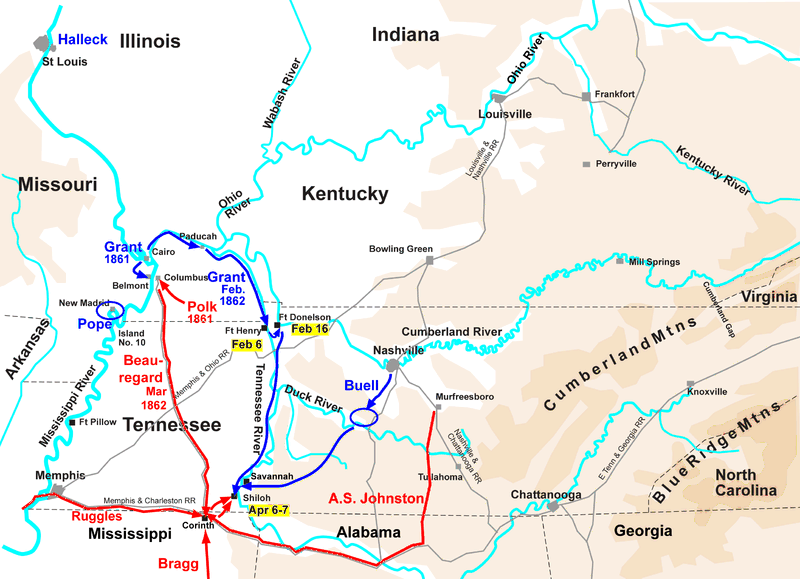
| Western Theater and Civil War Battle of Shiloh Map |
|
| Civil War Shiloh Map |
General Cleburne made honorable
mention of Colonel Bate, and said of his regiment: "Tennessee can never mourn for a nobler band than fell
this day in her Second regiment." He refers in terms of praise to Col. Matt Martin, Twenty-third Tennessee, who arrived on
the field pending the action, rallied his regiment and remained with it until wounded later in the day; also to the Twenty-fourth
Tennessee, which he said "won a character for steady valor, and its commander, Lieutenant. Colonel Peebles, showed that he
possessed all the qualifications of a commander in the field." The Thirty-fifth Tennessee, Col. Benjamin J. Hill, was conspicuous
in Cleburne's first and final charge on the enemy. General
Cleburne, concluding his report, said: "I would like to do justice to the many acts of individual valor and intrepid daring
during the fight .... Col. Ben Hill, Fifth Tennessee; Lieutenant-Colonel Peebles, Twenty-fourth Tennessee; Lieut. R.. H. Keeble,
Captain Ridley and Lieutenant-Colonel Neil of the Twenty-third Tennessee, were among the number." General Wood reported that
"Col. C. A. McDaniel, of the Forty-fourth Tennessee, acted with great bravery and directed his men with good judgment until
wounded on Monday." In his own report, Colonel McDaniel said that Lieutenant-Colonel Shied, of his regiment, was badly wounded
on the 6th, and that "his officers and men conducted themselves gallantly and chivalrously." The Fifty-fifth Tennessee, Col.
William McKoin, was in Wood's brigade, and held the right of Wood's line in the successful attack of the early morning on
the enemy's camp. Of Lieut.-Col. J. M. Crews, of Crews' battalion, Colonel Trabue reported that he "behaved well." The battalion
lost 55 in killed and wounded.
Forrest's regiment of cavalry added renown to
the reputation made at Fort Donelson.
He was in advance of Breckinridge as he moved out of Corinth,
covered the flank of our army with the greatest intelligence and courage, and participated in the movement which forced from
Prentiss all support on his left. On the morning of the 7th he gave notice of the advance of Nelson's division, made a dash
at his skirmish line, captured 50 prisoners, and held the enemy in check until ordered by General Hardee to retire. Colonel
Forrest was with Breckinridge in covering the Confederate retreat to Corinth,
and in a combat with the Federal advance was severely wounded.
After the abandonment
of the capital of Tennessee, Gov. Isham G. Harris determined
to promote the cause of the South at any sacrifice. No effort was left untried to induce continued enlistments in the army,
and every possible encouragement was offered to our people, in the districts outside of the Federal lines, to continue the
production of supplies for the army. Hearty responses were made to these calls, and the spirit of resistance was stimulated
by the governor's words and personal example. So soon as the army was concentrated at Corinth,
he reported for service to General Johnston and was assigned to duty as aide-de-camp. He was with the general on the field
of Shiloh, in the active performance of duty, and present when that great chieftain received
his death-wound. In General Beauregard's report of the battle it is recorded that "Gov. Isham G. Harris, of Tennessee, went
upon the field with General Johnston, was by his side when he was shot, aided him from his horse, and received him in his
arms when he died. Subsequently the governor joined my staff and remained with me throughout the next day, except when carrying
orders or employed in encouraging the troops of his own State, to whom he gave a conspicuous example of coolness, zeal and
intrepidity."
The Forty-seventh Tennessee regiment, Col. M. R. Hill, arrived
on the field on the morning of the 7th and reported to General Polk. It was poorly armed with sporting rifles and shotguns,
and before going into action was conducted by a staff officer of General Cheatham to the point where Prentiss surrendered,
and was at once armed with new Springfield muskets, and supplied
with ammunition, from the Federal store. It turned these guns upon the enemy, and made a good record with Cheatham (attached
to the brigade commanded by Col. Preston Smith) in his battle with McCook's division of Buell's army. There were three battalions
of regulars in Rousseau's brigade of this division, and of Buell's loss of 3,753, the heaviest part was sustained by McCook
in his combat with Cheatham.
The Tennessee
artillery--Bankhead's battery, Capt. Smith P. Bankhead; Polk's battery, Capt. M. Y. Polk; Rutledge's battery, Capt. A. M.
Rutledge--rendered conspicuous and valuable services. General Wood, reporting the battle of the 7th, testified that when "large
masses of the enemy were coming up and pressing my right, a battery, which I afterward learned was commanded by Captain Rutledge,
came up to this point and held them in check for more than half an hour." Captain Polk was seriously wounded on the 6th; Stanford's
Mississippi battery served with Stewart's brigade and rendered
good service.
Capt. Melancthon Smith's battery, composed of Mississippians,
was attached to Stephens', afterward Maney's, brigade. It entered the service with Cheatham and was mustered into the provisional
army of Tennessee. It was with Cheatham on the 6th and in
his battle of the 7th with McCook, and was referred to by General Cheatham as having rendered "splendid service," Captain
Smith and his officers and men being "distinguished examples of gallantry." Captain Smith was afterward major and colonel
of artillery. The battery continued with Cheatham until after the battle of Nashville, under
the command of Lieut. W. B. Turner, made captain after Chickamauga.
On the field of Shiloh, Captain Smith exchanged his 6-pounder guns for 12-pounders captured
from the enemy.
General Cheatham reported the death of Colonel Blythe and Lieutenant-Colonel
Herron of Blythe's Mississippi regiment, and the wounding of Gen. Bushrod R. Johnson, Col. R. C. Tyler (afterward brigadier-general)
of the Fifteenth Tennessee, and Captain Polk. Maj. R. P. Caldwell, Twelfth Tennessee, conspicuous for his bearing, reports
that after the commissioned officers of companies B and G had all been killed or disabled by wounds, Private A. T. Fielder
took charge of them "and led these two companies all day in the thickest part of the battle." Lieut.-Col. F. M. Stewart and
Capt. W. Dawson, Twenty-second Tennessee, were severely wounded. The Thirteenth lost 137 killed and wounded, among the former,
Lieuts. C. H. Whitmore and W. F. Cowan.
Col. A. W. Campbell of the Thirty-third,
afterward brigadier-general, reported that Maj. Henry C. McNeill displayed "throughout a cool bravery rarely equaled." The
regiment lost 123 killed and wounded. Col. Preston Smith reported that the officers and men of his brigade conducted themselves
well and courageously. The One Hundred and Fifty-fourth Tennessee lost 188 in killed and wounded.
The
great body of the Tennessee troops never fought better than at Shiloh.
Though many of them had little training, they fought in the open field and exhibited remarkable steadiness and readiness to
obey orders. While company and regimental organizations were observed, it was next to impossible to maintain brigade and division
organizations. The field seemed to be full of roving staff officers begging for a regiment to support a hard-pressed part
of the line. In many instances they assumed to be clothed with authority to order a regiment from its own brigade to another.
The consequence was that in a few hours after the opening of the battle the efficiency of the troops was seriously affected,
and some of them were made the victims of great injustice.
The retirement to
Corinth was made in good order. No pursuit was made or attempted.
General Beauregard reports the Confederate loss at 10,699. Swinton fixes the loss of Grant and Buell in killed, wounded and
captured, at 15,000.
Source: Confederate Military, Volume 8, Tennessee
Recommended
Reading: Shiloh--In Hell before Night. Description: James McDonough has written a good, readable and concise history of a battle that the author characterizes
as one of the most important of the Civil War, and writes an interesting history of this decisive 1862 confrontation in the
West. He blends first person and newspaper accounts to give the book a good balance between the general's view and the soldier's
view of the battle. Continued below…
Particularly
enlightening is his description of Confederate General Albert Sidney Johnston, the commander who was killed on the first day
of the battle. McDonough makes a pretty convincing argument that Johnston fell far short of the image that many give him
in contemporary and historical writings. He is usually portrayed as an experienced and decisive commander of men. This book
shows that Johnston was a man of modest war and command experience,
and that he rose to prominence shortly before the Civil War. His actions (or inaction) prior to the meeting at Shiloh -- offering
to let his subordinate Beauregard take command for example -- reveal a man who had difficulty managing the responsibility
fostered on him by his command. The author does a good job of presenting several other historical questions and problems like
Johnston's reputation vs. reality that really add a lot of
interest to the pages.
Recommended Reading: Shiloh: The Battle
That Changed the Civil War (Simon & Schuster). From Publishers Weekly: The
bloodbath at Shiloh, Tenn.
(April 6-7, 1862), brought an end to any remaining innocence in the Civil War. The combined 23,000 casualties that the two
armies inflicted on each other in two days shocked North and South alike. Ulysses S. Grant kept his head and managed, with
reinforcements, to win a hard-fought victory. Continued below…
Confederate
general Albert Sidney Johnston was wounded and bled to death, leaving P.G.T. Beauregard to disengage and retreat with a dispirited
gray-clad army. Daniel (Soldiering in the Army of Tennessee) has crafted a superbly researched volume that will appeal to
both the beginning Civil War reader as well as those already familiar with the course of fighting in the wooded terrain bordering
the Tennessee River.
His impressive research includes the judicious use of contemporary newspapers and extensive collections of unpublished letters
and diaries. He offers a lengthy discussion of the overall strategic situation that preceded the battle, a survey of the generals
and their armies and, within the notes, sharp analyses of the many controversies that Shiloh
has spawned, including assessments of previous scholarship on the battle. This first new book on Shiloh
in a generation concludes with a cogent chapter on the consequences of those two fatal days of conflict.
Recommended
Reading: Shiloh: A Novel, by Shelby
Foote. Review: In the novel Shiloh, historian and Civil War expert Shelby Foote delivers a spare, unflinching account of the
battle of Shiloh, which was fought over the course of two days in April 1862. By mirroring
the troops' movements through the woods of Tennessee with
the activity of each soldier's mind, Foote offers the reader a broad perspective of the battle and a detailed view of the
issues behind it. Continued below…
The battle
becomes tangible as Foote interweaves the observations of Union and Confederate officers, simple foot soldiers, brave men, and cowards and describes
the roar of the muskets and the haze of the gun smoke. The author's vivid storytelling creates a rich chronicle of a pivotal
battle in American history.
Recommended
Reading: Shiloh and the Western Campaign
of 1862. Review: The bloody and decisive two-day
battle of Shiloh (April 6-7, 1862) changed the entire course of the American Civil War. The
stunning Northern victory thrust Union commander Ulysses S. Grant into the national spotlight, claimed the life of Confederate
commander Albert S. Johnston, and forever buried the notion that the Civil War would be a short conflict. The conflagration
at Shiloh had its roots in the strong Union advance during the winter of 1861-1862 that resulted in the capture of Forts Henry
and Donelson in Tennessee. Continued below…
The offensive
collapsed General Albert S. Johnston advanced line in Kentucky and forced him to withdraw all the way to northern Mississippi. Anxious to attack the enemy, Johnston began
concentrating Southern forces at Corinth, a major railroad center just below the Tennessee border. His bold plan called for his Army of the Mississippi to march north and destroy General Grant's Army of the Tennessee
before it could link up with another Union army on the way to join him. On the morning of April 6, Johnston
boasted to his subordinates, "Tonight we will water our horses in the Tennessee!"
They nearly did so. Johnston's sweeping attack hit the unsuspecting Federal camps at Pittsburg
Landing and routed the enemy from position after position as they fell back toward the Tennessee River.
Johnston's sudden death in the Peach Orchard, however, coupled
with stubborn Federal resistance, widespread confusion, and Grant's dogged determination to hold the field, saved the Union
army from destruction. The arrival of General Don C. Buell's reinforcements that night turned the tide of battle. The next
day, Grant seized the initiative and attacked the Confederates, driving them from the field. Shiloh
was one of the bloodiest battles of the entire war, with nearly 24,000 men killed, wounded, and missing. Edward Cunningham,
a young Ph.D. candidate studying under the legendary T. Harry Williams at Louisiana
State University, researched and wrote Shiloh and the Western Campaign of 1862 in 1966. Although it remained unpublished, many Shiloh
experts and park rangers consider it to be the best overall examination of the battle ever written. Indeed, Shiloh
historiography is just now catching up with Cunningham, who was decades ahead of modern scholarship. Western Civil War historians
Gary D. Joiner and Timothy B. Smith have resurrected Cunningham's beautifully written and deeply researched manuscript from
its undeserved obscurity. Fully edited and richly annotated with updated citations and observations, original maps, and a
complete order of battle and table of losses, Shiloh and the Western Campaign of 1862 will
be welcomed by everyone who enjoys battle history at its finest. Edward Cunningham, Ph.D., studied under T. Harry Williams
at Louisiana State
University. He was the author of The Port Hudson Campaign: 1862-1863
(LSU, 1963). Dr. Cunningham died in 1997. Gary D. Joiner, Ph.D. is the author of One Damn Blunder from Beginning to End: The
Red River Campaign of 1864, winner of the 2004 Albert Castel Award and the 2005 A. M. Pate, Jr., Award, and Through the Howling
Wilderness: The 1864 Red River Campaign and Union Failure in the West. He lives in Shreveport,
Louisiana. About the Author: Timothy B. Smith, Ph.D., is author of Champion Hill:
Decisive Battle for Vicksburg (winner of the 2004 Mississippi
Institute of Arts and Letters Non-fiction Award), The Untold Story of Shiloh: The Battle and the Battlefield, and This Great
Battlefield of Shiloh: History, Memory, and the Establishment of a Civil War National Military Park. A former ranger at Shiloh,
Tim teaches history at the University of Tennessee.
Recommended
Reading: Seeing the Elephant: RAW RECRUITS AT THE BATTLE OF SHILOH. Description: One of the bloodiest battles in the Civil War, the
two-day engagement near Shiloh, Tennessee,
in April 1862 left more than 23,000 casualties. Fighting alongside seasoned veterans were more than 160 newly recruited regiments
and other soldiers who had yet to encounter serious action. In the phrase of the time, these men came to Shiloh
to "see the elephant". Continued below…
Drawing on
the letters, diaries, and other reminiscences of these raw recruits on both sides of the conflict, "Seeing the Elephant" gives
a vivid and valuable primary account of the terrible struggle. From the wide range of voices included in this volume emerges
a nuanced picture of the psychology and motivations of the novice soldiers and the ways in which their attitudes toward the
war were affected by their experiences at Shiloh.
Recommended Reading: The Battle of Shiloh and the Organizations Engaged (Hardcover). Description: How can an essential "cornerstone of
Shiloh historiography" remain unavailable to the general public for so long? That's what
I kept thinking as I was reading this reprint of the 1913 edition of David W. Reed's “The Battle of Shiloh and the Organizations
Engaged.” Reed, a veteran of the Battle of Shiloh and the first historian of the Shiloh National Military
Park, was tabbed to write the official history of the battle, and this
book was the result. Reed wrote a short, concise history of the fighting and included quite a bit of other valuable information
in the pages that followed. The large and impressive maps that accompanied the original text are here converted into digital
format and included in a CD located within a flap at the back of the book. Author and former Shiloh Park Ranger Timothy Smith
is responsible for bringing this important reference work back from obscurity. His introduction to the book also places it
in the proper historical framework. Continued below…
Reed's history of the campaign and battle covers only seventeen pages and is meant to be a brief history of the subject.
The detail is revealed in the rest of the book. And what detail there is! Reed's order of battle for Shiloh goes down to the regimental
and battery level. He includes the names of the leaders of each organization where known, including whether or not these men
were killed, wounded, captured, or suffered some other fate. In a touch not often seen in modern studies, the author also
states the original regiment of brigade commanders. In another nice piece of detail following the order of battle, staff officers
for each brigade and higher organization are listed. The book's main point and where it truly shines is in the section entitled
"Detailed Movements of Organizations". Reed follows each unit in their movements during the battle. Reading this section along
with referring to the computerized maps gives one a solid foundation for future study of Shiloh.
Forty-five pages cover the brigades of all three armies present at Shiloh.
Wargamers and buffs will love the "Abstract of Field Returns". This section lists Present for Duty, engaged, and casualties
for each regiment and battery in an easy to read table format. Grant's entire Army of the Tennessee has Present for Duty strengths. Buell's Army of the Ohio is also counted well. The Confederate Army of the Mississippi
is counted less accurately, usually only going down to brigade level and many times relying only on engaged strengths. That
said, buy this book if you are looking for a good reference work for help with your order of battle.
In what I believe is an unprecedented move in Civil War literature, the University
of Tennessee Press made the somewhat unusual decision to include Reed's
detailed maps of the campaign and battle in a CD which is included in a plastic sleeve inside the back cover of the book.
The cost of reproducing the large maps and including them as foldouts or in a pocket in the book must have been prohibitive,
necessitating this interesting use of a CD. The maps were simple to view and came in a PDF format. All you'll need is Adobe
Acrobat Reader, a free program, to view these. It will be interesting to see if other publishers follow suit. Maps are an
integral part of military history, and this solution is far better than deciding to include poor maps or no maps at all. The
Read Me file that came with the CD relays the following information:
-----
The maps contained on this CD are scans of the original oversized maps printed in the 1913 edition of D. W. Reed's
The Battle of Shiloh and the Organizations Engaged. The original maps, which were in a very large format and folded out of
the pages of this edition, are of varying sizes, up to 23 inches by 25 inches. They were originally created in 1901 by the
Shiloh National Military Park under the direction of its historian,
David W. Reed. They are the most accurate Shiloh battle maps in existence.
The maps on the CD are saved as PDF (Portable Document Format) files and can be read on any operating system (Windows,
Macintosh, Linux) by utilizing Adobe Acrobat Reader. Visit http://www.adobe.com to download Acrobat Reader if you do not have
it installed on your system.
Map 1. The Field of Operations from Which the Armies Were Concentrated at Shiloh,
March and April 1862
Map 2. The Territory between Corinth, Miss., and Pittsburgh Landing, Tenn., Showing Positions and Route of the Confederate
Army in Its Advance to Shiloh, April 3, 4, 5, & 6, 1862
Map 3. Positions on the First Day, April 6, 1862
Map 4. Positions on the Second Day, April 7, 1862
Complete captions appear on the maps.
-----
Timothy Smith has done students of the Civil War an enormous favor by republishing this important early work on Shiloh. Relied on for generations by Park Rangers and other serious students of the battle, The Battle
of Shiloh and the Organizations Engaged has been resurrected for a new generation of Civil War readers. This classic reference
work is an essential book for those interested in the Battle of Shiloh. Civil War buffs, wargamers, and those interested in
tactical minutiae will also find Reed's work to be a very good buy. Highly recommended.
|
