|
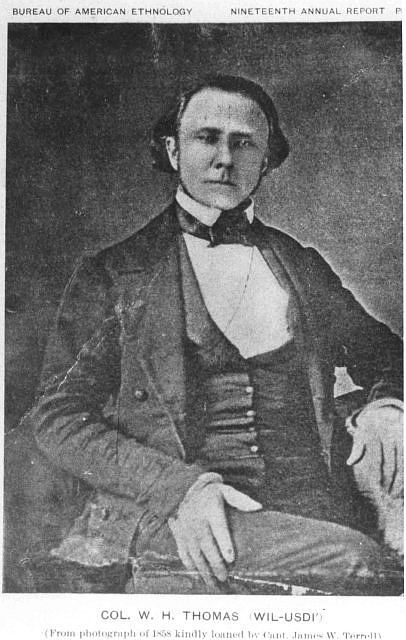
| William H. Thomas |
|
| Cherokee Chief William Holland Thomas |
The Emotional, Financial, and Physical Toll
(A Summary)
The Cherokees' lawsuits
against Thomas, in essence, blocked the creditors from being awarded the land that rightfully belonged to the Cherokees.
Summary
Although a very wealthy man, Thomas's
selflessness and profound generosity kept him in debt and on the constant brink of bankruptcy. For months and sometimes years,
many Indians purchased goods on credit at Thomas's stores. However, although the Cherokee were hard workers, employment
in the region was scarce. As a consequence, many were unable to compensate Thomas, but even when he didn't receive
payment he continued to meet their needs.
Results of a Civil War
Results of the Civil War for Confederate
Colonel and Cherokee Chief William Holland Thomas: bankrupt; plagued by disease(s); Chief Thomas's ill health created leadership void in the Eastern Cherokee thus causing internal strife
and bitterness; Civil War defeat for the Cherokee promoted anger, by some, toward Thomas; Civil War had left Thomas bankrupt
and therefore his creditors had sued and confiscated the deeds to his land/holdings and also the deeds to the land that he
had held in trust for the Cherokee; then, upon government recognition of the Cherokee rights to that land, some of the Cherokee
sued Thomas for the land deeds that he had held in trust--Cherokee were previously not citizens and therefore were not
entitled to own land (see: Cherokee Treaties and Cherokee Tribal Government: Historical Summary). So, Thomas had held the deeds to thousands of acres on behalf of the Cherokee;
the litigation* lasted for several years. Thomas did not receive personal gain from the lands that he had held for the Cherokee:
plain and simple, the war had left Thomas emotionally, physically and financially bankrupt.
*Legal Proceedings
The plaintiffs, the Cherokee Band, were
forced to sue Thomas to reclaim their lawful lands. Later, the plaintiffs, the Cherokee that had filed the lawsuits, apologized
to Thomas because of the litigation. Thomas harbored no ill feelings and even understood that the lawsuits were warranted; many
of the Cherokee wept.
Why Litigation?
1) Creditors sued Thomas and were awarded his assets; 2) Assets included
the Cherokee land deeds that Thomas had held in trust, as well as Thomas’s assets; 3) The only way to exempt the creditors
from being awarded the Cherokee land, which Thomas had held in trust, was for the Cherokee to sue Thomas proving that they
owned the land and that Thomas had only held it in trust; 4) The courts, having viewed legal documents reflecting that Thomas
had held the deeds in trust, then awarded the Cherokee their land. The Cherokee lawsuits against Thomas, in essence, blocked
the creditors from being awarded the land that rightfully belonged to the Eastern Band.
The Legacy
William Holland Thomas's Legacy:
Thomas's land purchases constitute much of the Qualla Boundary (Eastern Cherokee Nation),
and Paint Town, Bird Town, Yellow Hill, Big Cove and Wolf Town were also named by Thomas. Near the Qualla Boundary a
monument dedicated to Thomas reflects that he was "The
best friend the Cherokees ever had."
Related Reading:
Highly
Recommended Reading:
Storm in the Mountains: Thomas' Confederate
Legion of Cherokee Indians and Mountaineers (Thomas'
Legion: The Sixty-ninth North Carolina Regiment). Vernon H. Crow, Storm in the Mountains,
spent 10 years conducting extensive Thomas Legion's research. Crow was granted access to rare manuscripts, special collections, and
privately held diaries which add great depth to this rarely discussed Civil War legion. He explores and discusses the
unit's formation, fighting history, and life of the legion's commander, a Cherokee chief and Confederate colonel, William
Holland Thomas. Continued...
Numerous maps and photographs allow the reader to better understand and
relate to the subjects discussed. It also contains rosters which is an added bonus for researchers and genealogists. Crow,
furthermore, left no stone unturned while examining the many facets of the Thomas Legion and his research is conveyed on a
level that scores with Civil War students and scholars alike.
Recommended
Reading: Shook over Hell: Post-Traumatic
Stress, Vietnam,
and the Civil War. Description: Eric T. Dean Jr., a lawyer
whose interest in the Civil War prompted him to return to school to obtain a Ph.D. in history, makes a unique contribution
to Civil War studies with his research on the psychological effects of the war on its veterans. Digging through the pension
records of Civil War vets, Dean documents the great number who, suffering from severe psychological problems triggered by
intense combat experience, were dutifully provided with disability pensions by the U.S. government. Continued...
Dean's central thesis--that these veterans provide a mirror
for the experiences of their counterparts in Vietnam a century later--is supported with lucid reasoning. Of particular interest
are the many stories of intense Civil War combat and its psychological aftereffects, including many cases of Civil War veterans
committed to asylums well into the 1890s--case studies seldom found in standard histories which offer painful testimony to
the war's enormous impact on the nation.
Try the Search Engine for Related Studies: William Holland Thomas versus Eastern Cherokee Indians lawsuit,
court case legal proceedings, litigation, Cherokees v Thomas North Carolina landholding dispute lawsuits, lands hearings,
court case.
|
