|
Battle of the Alamo History
The siege and the final assault
on the Alamo, February 23, 1836 - March 6, 1836, constitute the most celebrated military engagement in Texas
history.
BATTLE OF THE ALAMO HISTORY
| Battle of the Alamo, San Antonio, Texas, History |
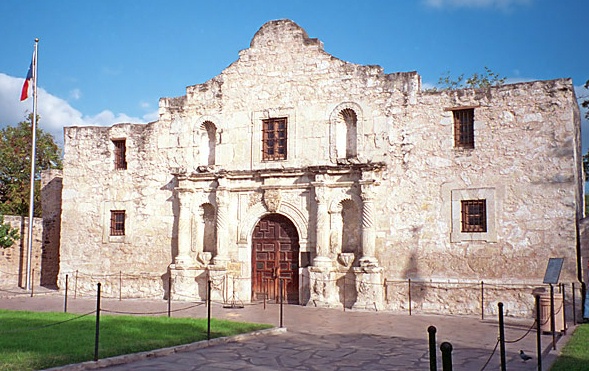
|
| Battle of the Alamo, Texas History |
The Battle of the Alamo, fought during the
Texas War of Independence, known also as the Texas Revolution, was conspicuous for the large number of illustrious personalities
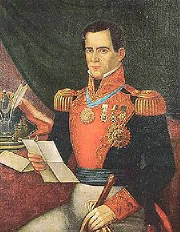
among its combatants. These included Tennessee congressman David (Davy) Crockett, entrepreneur-adventurer James Bowie, and Mexican president Antonio López de Santa Anna. Although not nationally famous at the time, William Barret Travis achieved lasting distinction as commander
at the Alamo. For many Americans and most Texans, the battle has become a symbol of patriotic
sacrifice. Traditional popular depictions, including novels, stage plays, and motion pictures, emphasize legendary aspects
that often obscure the historical event.
| Battle of the Alamo History |
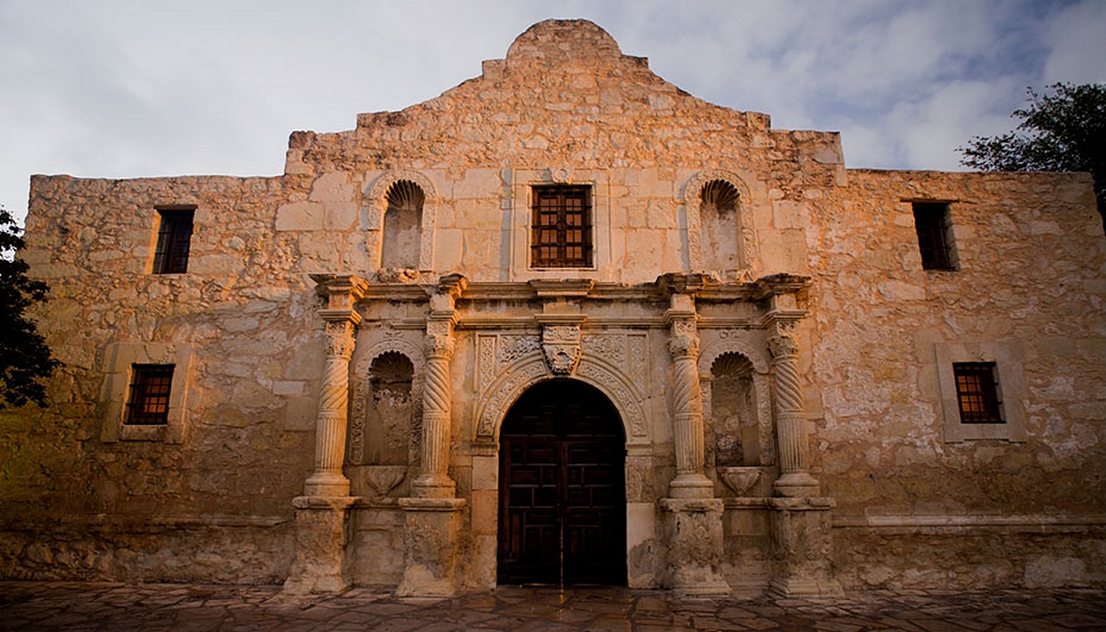
|
| Battle of the Alamo, San Antonio |
| Battle of the Alamo History |
|
| Battle of the Alamo Texas |
To understand the real battle, one must
appreciate its strategic context in the Texas Revolution. In December 1835, a Federalist army of Texan (or Texian, as they
were called) immigrants, American volunteers, and their Tejano allies had captured the town from a Centralist force during
the siege of Bexar. With that victory, a majority of the Texan volunteers of the "Army of the People" left service and returned
to their families. Nevertheless, many officials of the provisional government feared the Centralists would mount a spring
offensive.
| Battle of the Alamo |
|
| Antonio López de Santa Anna |
Two main roads led into Texas
from the Mexican interior. The first was the Atascosito Road,
which stretched from Matamoros on the Rio Grande northward through
San Patricio, Goliad, Victoria, and finally into the heart
of Austin's colony. The second was the Old San Antonio Road,
a camino real that crossed the Rio Grande at Paso de Francia (the San Antonio Crossing) and wound northeastward through
San Antonio de Béxar, Bastrop, Nacogdoches, San Augustine, and across the Sabine River into Louisiana. Two forts blocked these
approaches into Texas: Presidio La Bahía (Nuestra Señora de Loreto Presidio) at Goliad and
the Alamo at San Antonio. Each installation functioned as
a frontier picket guard, ready to alert the Texas settlements
of an enemy advance. James Clinton Neill received command of the Bexar garrison. Some ninety miles to the southeast, James
Walker Fannin, Jr., subsequently took command at Goliad. Most Texan settlers had returned to the comforts of home and hearth.
Consequently, newly arrived American volunteers-some of whom counted their time in Texas
by the week-constituted a majority of the troops at Goliad and Bexar. Both Neill and Fannin determined to stall the Centralists
on the frontier. Still, they labored under no delusions. Without speedy reinforcements, neither the Alamo
nor Presidio La Bahía could long withstand a siege.
| Battle of the Alamo |
|
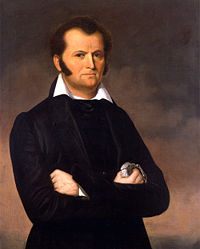
| James (Jim) Bowie |
At Bexar were some twenty-one artillery pieces
of various calibers. Because of his artillery experience and his regular army commission, Neill was a logical choice to command.
Throughout January he did his best to fortify the mission fort on the outskirts of town. Maj. Green B. Jameson, chief engineer
at the Alamo,
installed most of the cannons on the walls. Jameson boasted to Gen. Sam Houston that if the Centralists stormed the Alamo, the defenders could "whip 10 to 1 with our artillery." Such predictions proved excessively optimistic.
Far from the bulk of Texas settlements, the Bexar garrison
suffered from a lack of even basic provender. On January 14, Neill wrote Houston
that his people were in a "torpid, defenseless condition." That day he dispatched a grim message to the provisional government:
"Unless we are reinforced and victualled, we must become an easy prey to the enemy, in case of an attack."
By January 17, Houston had begun to question the wisdom of maintaining Neill's garrison at Bexar. On that
date he informed Governor Henry Smith that Col. James Bowie and a company of volunteers had left for San Antonio. Many have cited this letter as proof that Houston
ordered the Alamo abandoned. Yet, Houston's
words reveal the truth of the matter:
"I have ordered the fortifications in the
town of Bexar to be demolished, and, if you should think well of it, I will remove all the cannon and other munitions
of war to Gonzales and Copano, blow up the Alamo and abandon the place, as it will be impossible to keep up the Station with
volunteers, the sooner I can be authorized the better it will be for the country [italics added]."
| Battle of the Alamo History |
|
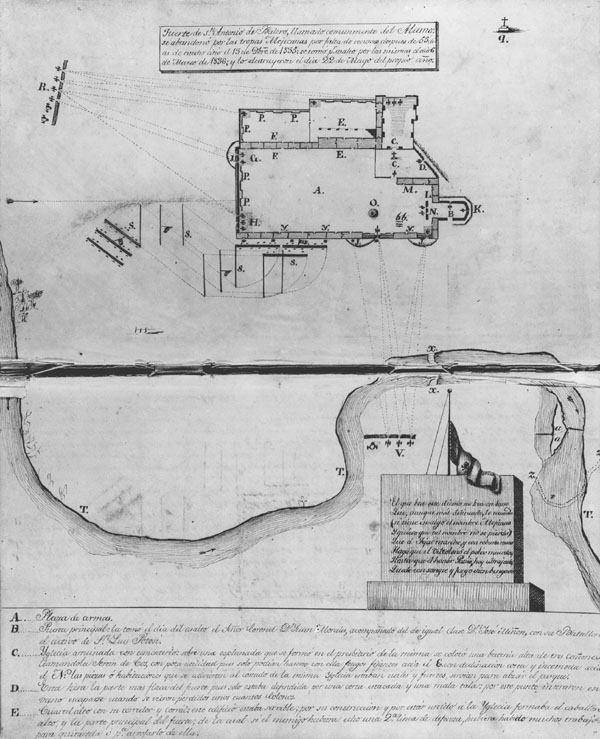
| Alamo Attack Plan by José Juan Sánchez-Navarro in 1836. |
This plan of the Alamo was created by José Juan Sánchez-Navarro in 1836.
Places marked R and V denote Mexican cannon; position S indicates Cos's forces.
| Battle of the Alamo |
|
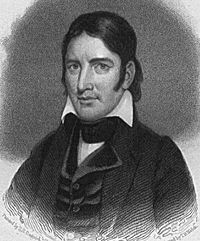
| David (Davy) Crockett |
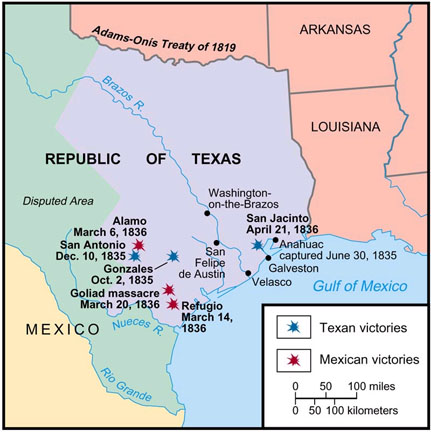
| Location and Date of Battle of the Alamo Map |
|
| Map of the Battle of the Alamo and Texas Revolution |
Houston may have wanted to raze
the Alamo, but he was clearly requesting Smith's consent. Ultimately, Smith did not "think
well of it" and refused to authorize Houston's proposal.
On January 19, Bowie
rode into the Alamo compound, and what he saw impressed him. As a result of much hard work,
the mission had begun to look like a fort. Neill, who well knew the consequences of leaving the camino real unguarded,
convinced Bowie that the Alamo was the only post between the
enemy and Anglo settlements. Neill's arguments and his leadership electrified Bowie.
"I cannot eulogize the conduct & character of Col. Neill too highly," he wrote Smith; "no other man in the army could
have kept men at this post, under the neglect they have experienced." On February 2, Bowie
wrote Smith that he and Neill had resolved to "die in these ditches" before they would surrender the post. The letter confirmed
Smith's understanding of controlling factors. He had concluded that Bexar must not go undefended. Rejecting Houston's
advice, Smith prepared to funnel additional troops and provisions to San Antonio.
In brief, Houston had asked for permission to abandon the
post. Smith considered his request. The answer was no.
Colonel Neill had complained that "for want
of horses," he could not even "send out a small spy company." If the Alamo were to function
as an early-warning station, Neill had to have outriders. Now fully committed to bolstering the Bexar garrison, Smith directed
Lt. Col. William B. Travis to take his "Legion of Cavalry" and report to Neill. Only thirty horsemen responded to the summons.
Travis pleaded with Governor Smith to reconsider: "I am unwilling to risk my reputation (which is ever dear to a soldier)
by going off into the enemy's country with such little means, and with them so badly equipped." Travis threatened to resign
his commission, but Smith ignored these histrionics. At length, Travis obeyed orders and dutifully made his way toward Bexar
with his thirty troopers. Reinforcements began to trickle into Bexar. On February 3, Travis and his cavalry contingent reached
the Alamo. The twenty-six-year-old cavalry officer had traveled to his new duty station under
duress. Yet, like Bowie, he soon became committed to Neill and the fort, which he began to
describe as the "key to Texas." About February 8, David
Crockett arrived with a group of American volunteers.
| Battle of the Alamo History |
|
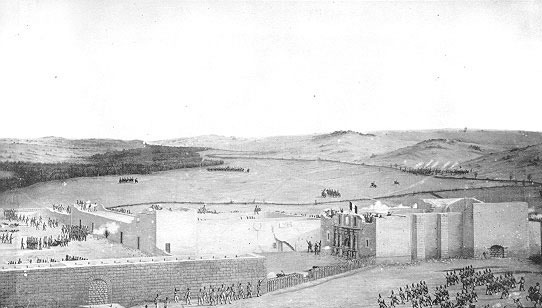
| Fall of the Alamo, painted by Theodore Gentilz in 1844. |
The Fall of the Alamo, painted by Theodore Gentilz in 1844, depicts the
Alamo complex from the south. The Low Barracks, the chapel, and the wooden palisade connecting them are in the foreground.
| Battle of the Alamo |
|
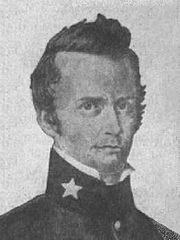
| William Travis |
On February 14, Neill departed on furlough.
He learned that illness had struck his family and that they desperately needed him back in Bastrop.
While on leave, Neill labored to raise funds for his Bexar garrison. He promised that he would resume command when circumstances
permitted, certainly within twenty days, and left Travis in charge as acting post commander. Neill had not intended to slight
the older and more experienced Bowie, but Travis, like Neill,
held a regular army commission. For all of his notoriety, Bowie
was still just a volunteer colonel. The Alamo's volunteers, accustomed to electing their
officers, resented having this regular officer foisted upon them. Neill had been in command since January; his maturity, judgment,
and proven ability had won the respect of both regulars and volunteers. Travis, however, was unknown. The volunteers insisted
on an election, and their acting commander complied with their wishes. The garrison cast its votes along party lines: the
regulars voted for Travis, the volunteers for Bowie. In a
letter to Smith, Travis claimed that the election and Bowie's
subsequent conduct had placed him in an "awkward situation." The night following the balloting, Bowie dismayed Bexar residents with his besotted carousal. He tore through the town, confiscating
private property and releasing convicted felons from jail. Appalled by this disorderly exhibition, Travis assured the governor
that he refused to assume responsibility "for the drunken irregularities of any man"-not even the redoubtable Jim Bowie. Fortunately,
this affront to Travis's sense of propriety did not produce a lasting breach between the two commanders. They struck a compromise:
Bowie would command the volunteers, Travis the regulars. Both
would co-sign all orders and correspondence until Neill's return. There was no more time for personality differences. They
had learned that Santa Anna's Centralist army had reached the Rio Grande.
Though Travis did not believe that Santa Anna could reach Bexar until March 15, his arrival on February 23 convinced him otherwise.
As Texans gathered in the Alamo, Travis dispatched a hastily scribbled missive to Gonzales:
"The enemy in large force is in sight. We want men and provisions. Send them to us. We have 150 men and are determined to
defend the garrison to the last." Travis and Bowie understood that the Alamo could not hold
without additional forces. Their fate now rested with the General Council in San Felipe, Fannin at Goliad, and other Texan
volunteers who might rush to assist the beleaguered Bexar garrison.
| Battle of the Alamo |
|
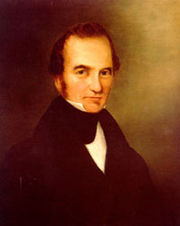
| Stephen F. Austin |
Santa Anna sent a courier to demand that
the Alamo
surrender. Travis replied with a cannonball. There could be no mistaking such a concise response. Centralist artillerymen
set about knocking down the walls. Once the heavy pounding reduced the walls, the garrison would have to surrender in the
face of overwhelming odds. Bottled up inside the fort, the Texans had only one hope-that reinforcements would break the siege.
On February 24, Travis assumed full command
when Bowie fell victim to a mysterious malady variously described
as "hasty consumption" or "typhoid pneumonia." As commander, Travis wrote his letter addressed to the "people of Texas & all Americans in the world," in which he recounted that
the fort had "sustained a continual Bombardment and cannonade for 24 hours." He pledged that he would "never surrender or
retreat" and swore "Victory or Death." The predominant message, however, was an entreaty for help: "I call on you in the name
of Liberty, of patriotism & everything dear to the American
character, to come to our aid, with all dispatch." On March 1, thirty-two troops attached to Lt. George C. Kimbell's Gonzales
ranging company made their way through the enemy cordon and into the Alamo. Travis was grateful
for any reinforcements, but knew he needed more. On March 3, he reported to the convention at Washington-on-the-Brazos that
he had lost faith in Colonel Fannin. "I look to the colonies alone for aid; unless it arrives soon, I shall have to fight
the enemy on his own terms." He grew increasingly bitter that his fellow Texans seemed deaf to his appeals. In a letter to
a friend, Travis revealed his frustration: "If my countrymen do not rally to my relief, I am determined to perish in the defense
of this place, and my bones shall reproach my country for her neglect."
| Battle of the Alamo History |
|
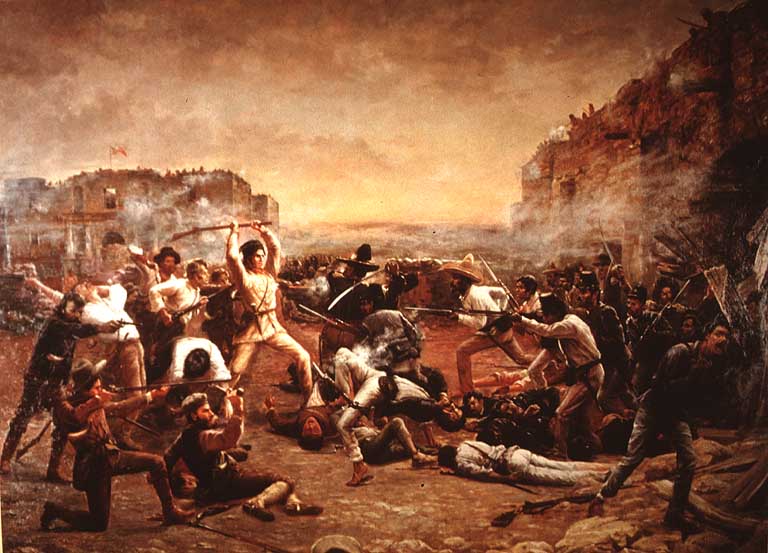
| San Antonio, Texas, Battle of the Alamo History |
The Fall of the Alamo (1903) by Robert Jenkins Onderdonk, depicts Davy Crockett
wielding his rifle as a club against Mexican troops who have breached the walls of the mission.
| Battle of the Alamo |
|
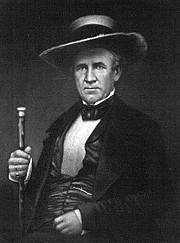
| Sam Houston |
On March 5, day twelve of the siege, Santa
Anna announced an assault for the following day. This sudden declaration stunned his officers. The enemy's walls were crumbling.
No Texan relief column had appeared. When the provisions ran out, surrender would remain the rebels' only option. There was
simply no valid military justification for the costly attack on a stronghold bristling with cannons. But ignoring these reasonable
objections, Santa Anna stubbornly insisted on storming the Alamo. Around 5:00 A.M. on Sunday, March 6, he hurled his columns at the battered walls
from four directions. Texan gunners stood by their artillery. As about 1,800 assault troops advanced into range, canister
ripped through their ranks. Staggered by the concentrated cannon and rifle fire, the Mexican soldiers halted, reformed, and
drove forward. Soon they were past the defensive perimeter. Travis, among the first to die, fell on the north bastion. Abandoning
the walls, defenders withdrew to the dim rooms of the Long Barracks. There some of the bloodiest hand-to-hand fighting occurred.
Bowie, too ravaged by illness to rise from his bed, found
no pity. The chapel fell last. By dawn the Centralists had carried the works. The assault had lasted no more than ninety minutes.
As many as seven defenders survived the battle, but Santa Anna ordered their summary execution. Many historians count Crockett
as a member of that hapless contingent, an assertion that still provokes debate in some circles. By eight o'clock every Alamo fighting man lay dead. Currently, 189 defenders appear on the official list, but ongoing research
may increase the final tally to as many as 257.
| Battle of the Alamo |
|
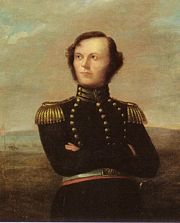
| James Fannin |
Though Santa Anna had his victory, the common
soldiers paid the price as his officers had anticipated. Accounts vary, but best estimates place the number of Mexicans killed
and wounded at about 600. Mexican officers led several noncombatant women, children, and slaves from the smoldering compound.
Santa Anna treated enemy women and children with admirable gallantry. He pledged safe passage through his lines and provided
each with a blanket and two dollars. The most famous of these survivors were Susanna W. Dickinson, widow of Capt. Almaron
Dickinson, and their infant daughter, Angelina Dickinson. After the battle, Mrs. Dickinson traveled to Gonzales. There, she
reported the fall of the post to General Houston. The sad intelligence precipitated a wild exodus of Texan settlers called
the Runaway Scrape.
What of real military value did the defenders'
heroic stand accomplish? Some movies and other works of fiction pretend that Houston used the time to raise an army. During most of the
siege, however, he was at the Convention of 1836 at Washington-on-the-Brazos and not with the army. The delay did, on the
other hand, allow promulgation of independence, formation of a revolutionary government, and the drafting of a constitution.
If Santa Anna had struck the Texan settlements immediately, he might have disrupted the proceedings and driven all insurgents
across the Sabine River. The men of the Alamo were valiant
soldiers, but no evidence supports the notion-advanced in the more perfervid versions-that they "joined together in an immortal
pact to give their lives that the spark of freedom might blaze into a roaring flame." Governor Smith and the General Council
ordered Neill, Bowie, and Travis to hold the fort until support
arrived. Despite all the "victory or death" hyperbole, they were not suicidal. Throughout the thirteen-day siege, Travis never
stopped calling on the government for the promised support. The defenders of the Alamo willingly
placed themselves in harm's way to protect their country. Death was a risk they accepted, but it was never their aim. Torn
by internal discord, the provisional government could not deliver on its promise to provide relief, and Travis and his command
paid the cost of that dereliction. As Travis predicted, his bones did reproach the factious politicos and the parade ground
patriots for their neglect. Even stripped of chauvinistic exaggeration, however, the battle of the Alamo remains an inspiring
moment in Texas history. The sacrifice of Travis and his
command animated the rest of Texas and kindled a righteous wrath that swept the Mexicans
off the field at San Jacinto. Since 1836, Americans on battlefields over the globe have responded
to the exhortation, "Remember the Alamo!" See also: Battle of the Alamo: A History and The Texas Revolution and Texas War of Independence.
(Bibliography and related reading
below)
Recommended
Reading: Battle of the Alamo; Remember the Alamo!
Try the Search Engine for Related Studies: Battle
of the Alamo History Texas Alamo Battle San Antonio Battle of the Alamo Davy Crockett Jim Bowie Sam Houston Facts Travis How
many died Battle Alamo Mexico total killed Mexican Soldiers Army.
BIBLIOGRAPHY: Library of Congress; National
Archives; Stephen L. Hardin, Texian Iliad: A Military History of the Texas Revolution (Austin: University of Texas Press,
1994); John H. Jenkins, ed., The Papers of the Texas Revolution, 1835-1836 (10 vols.,
Austin: Presidial Press, 1973); Walter Lord, A Time to
Stand (New York: Harper, 1961; 2d ed., Lincoln: University of Nebraska Press, 1978). Copyright © Texas State Historical
Association, Stephen L. Hardin.
|
