|
General John Bell Hood: The Texas Brigade
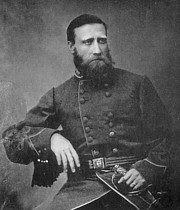
| General John Bell Hood |
|
| Dyer, The Gallant Hood |
John Bell Hood was a likeable person- tall and handsome with piercing blue eyes, with long, sandy blonde
hair, and possessing a strong, booming voice. Even in full dress uniform, his ruggedness shown through. He was a favorite
with the men in his command. One remembered the general as "a tall, rawboned country-looking man, with little of the soldierly
appearance that West Point often gave its graduates." Another recalled that Hood "had a personality that would attract attention
anywhere." He was utterly fearless in battle, a quality that earned him the respect of the men of his brigade and throughout
the Confederacy. Luck was also on his side for he had not been injured in the battles in which he had participated prior
to Gettysburg.
Born in Kentucky in 1831, Hood was the son of a doctor who enjoyed a successful practice and owned land,
slaves and horses. As a boy, he immediately took to horseback riding, fishing and hunting, and earned something of a reputation
for his unruliness. His father hoped his son would study medicine but Hood was more interested in adventure, the kind an army
career offered. Hood's uncle, a U.S. Congressman, managed to obtain an appointment for him to West Point where he excelled
in sports but struggled with academics. He later admitted that he was "more wedded to boyish sports than to books." In 1852
the academy received a new superintendent, Colonel Robert E. Lee, who Hood came to know and greatly respect. Little did either man imagine how their association would change
within the next ten years.
"Dissatisfied with his native Kentucky's neutrality, Hood declared himself a Texan"
Hood graduated 44 out of 52 in the class of 1853, and was sent to an
infantry post in California before his transfer to the 2nd U.S. Cavalry in Texas. When the Civil War commenced in 1861,
Lieutenant Hood’s sympathies were with the South; although his home state of Kentucky did not secede. He resigned from
the army, offered his services to the Confederate States, and was commissioned a colonel in command of the 4th Texas Infantry.
Subsequently, the regiment was sent to Virginia. In the winter of 1862, he was promoted to brigadier general and ordered to
take command of what was called the "Texas Brigade." The Texas Brigade, however, contained Georgia as well
as Texas units. On June 27, 1862, Hood led his brigade into combat at the Battle of Gaines' Mill, northeast of Richmond, Virginia. It was a costly battle for the new brigadier,
and his brigade lost 87 men killed and 425 wounded. It was his command that broke through the Union defenses, but
it may have been his prudent leadership that won the day. One of his soldiers recalled: "I tell you what.... I got
mighty nervous and shaky while we were forming in the apple orchard to make that last desperate charge on the batteries. But
when I looked behind me and saw old Hood... looking as unconcerned as if we were on dress parade, I just determined that if
he could stand it, I would."
Hood led the Texas Brigade through the Battles of Second Manassas, South Mountain, and Sharpsburg (aka Antietam) where he commanded a division of two brigades. At Sharpsburg in the bitterly contested Miller corn field,
Hood suffered 1,000 casualties in his 2,000 man command. After the battle, General Thomas Jonathan "Stonewall" Jackson recommended that Hood be promoted to major general. Jackson also proclaimed: "I regard him as one of the most promising
officers of the army." As a newly appointed major general, Hood, with his division, avoided heavy fighting
at the Battle of Fredericksburg, after which his division was ordered to Suffolk, Virginia, where they collected supplies
for the army and sparred with a Union force which occupied the city. During this time, he met Sally Preston, a pretty, sophisticated
young woman who was a member of Richmond's social elite. Hood was immediately taken by Preston, who was nicknamed "Buck."
After the Battle of Chancellorsville, Hood's division was ordered back to Northern Virginia. By mid-June, Hood and his 8,000 men had rejoined the Army of Northern Virginia and camped near Culpeper Court House prior to its march toward Pennsylvania.
"Do your best, Sam," Longstreet to Hood at the Battle of Gettysburg
General Hood's contempt for the ground he was to attack on July 2 at Gettysburg
is well documented. The long, tiring march of 18 miles, a precious few moments to rest his men before going into battle, and
the strength of Union artillery positions frustrated him. As he rode into battle with his troops, a large fragment of a Union
artillery shell slashed into the general's arm, tearing away much of the muscle and some of the bone. Pale and weak, Hood
was taken to a field hospital where doctors decided not to amputate the arm, believing that it could be saved. Hood was grateful,
but the damage was so severe that the arm was useless. He carried it in a sling for the rest of his life.
General Hood, not yet fully recovered from his Gettysburg wound, accompanied
his division to Georgia that fall and was severely wounded in the leg at the Battle of Chickamauga in September 1863. This time, surgeons could not save his shattered limb and amputated before infection could
set in. Though crippled and suffering, Hood's will to serve the Confederacy had not waned. In 1864, he was assigned to command
a corps in the Confederate Army in Georgia under Joseph Johnston. After the army had become nearly surrounded on the outskirts
of Atlanta, Hood was promoted and assumed command. The aggressive spirit still in him, the general ventured out
of the city's defenses to attack encircling Union forces under General William T. Sherman.
The Battle of Atlanta was a devastating Confederate defeat; Hood fell back into Atlanta's
weakened defenses and then he attempted to draw the Yankee army out of Georgia by invading Tennessee. The battles
of Franklin and Nashville resulted in additional disasters. Thoroughly dejected, Hood asked to be relieved of command after
the Battle of Nashville; his service to the Confederacy had ended.
At war's end, Hood surrendered to Federal authorities in Natchez, Mississippi.
After he was paroled and signed an oath of allegiance, he decided to relocate his family to New Orleans, Louisiana, where
it appeared he could prosper. Hood opened a modestly successful law office in the city and dealt in land speculation through
the period of reconstruction. In 1879, the New Orleans yellow fever epidemic claimed the lives of his wife and one of their
children. Crippled, the gallant Hood also succumbed to that disease on August 30, 1879, and is buried next to his wife
and child in Metairie Cemetery, New Orleans.
(Sources listed at bottom of page.)
Recommended Reading: Advance And Retreat: Personal Experiences In The United States
And Confederate States Armies, by General John Bell Hood. Description:
When John Bell Hood entered into the services of the Confederate Army, he was 29 years old, a handsome man and courageous
soldier, loyal to the ideal of Confederate Independence and eager to fight for it. He led his men bravely into the battles
of Second Manassas, Gaines’s Mill, Sharpsburg, Fredericksburg,
Gettysburg, and Chickamauga.
He rose fast, attaining the temporary rank of full general, only to fall faster. Hood emerged from the war with his left arm
shattered and useless, his right leg missing, his face aged far beyond his 33 years, and with his military reputation in disgrace.
Continued below.
Blamed by contemporaries for contributing to the defeat
of his beloved Confederacy, Hood struggled to refute their accusations. His most vehement critic, General Johnston, charged
Hood with insubordination while serving under him and, after succeeding him in command, of recklessly leading Confederate
troops to their “slaughter” and “useless butchery.” Sherman, too, in his Memoirs took a harsh view of Hood.
Born of controversy, Advance and Retreat is of course a highly controversial book. It is also full of invaluable information
and insights into the retreat from Dalton in early 1864, the fighting around Atlanta, and the disastrous Tennessee Campaign in winter of that year. Far from being a careful,
sober, objective account, this book is the passionate, bitter attempt of a soldier to rebut history’s judgment of himself
as general and man.
Advance to:
Recommended Reading:
John Bell Hood and the War for Southern Independence.
Description: John Bell Hood, a native of Kentucky, bred on romantic notions of the Old South and determined to model himself
on Robert E. Lee, had a tragic military career, no less interesting for being calamitous. After conspicuous bravery in leading
a Texas brigade, he rose in the ranks to become the youngest
of the full generals of the Confederacy. The misfortune in store for Hood, a far better fighter than a strategist, illustrates
the strain and risks of high command. Continued below.
One of the lasting images to come
out of the Civil War is that of the one-legged General Hood strapped in his saddle, leading his men in a hopeless counter-offensive
against Sherman's
march on Atlanta. In this prize-winning book, Richard M. McMurry
spares no details of Hood's ultimate "complete and disastrous failure," but he is concerned to do justice to one of the most
maligned and misunderstood figures in Civil War history. Reviews: "McMurry presents a terse, sharply focused portrait of the
controversial [Hood] that never wanders from his subject or smothers him with superfluous battlefront details... His treatment
of key turning points in the Texan's career is reasoned and thorough in its analysis."--Journal of Southern History. "McMurry is a fine campaign historian and excellent researcher. He chronicles the events
of Hood's life well."--American Historical Review.
Recommended Reading: John
Bell Hood And the Struggle for Atlanta (Civil
War Campaigns and Commanders Series). Description: "At thirty-three years of age, Hood became the eighth and youngest of the
Confederate Army's generals of full rank. He had risen through the commissioned ranks, from first lieutenant to full general,
in only three years, a feat achieved by no other man during the Civil War. . . . Ultimately, Hood was selected for one reason--to
fight--and no other available officer was better suited for the challenge." David Coffey's words give a succinct portrait
of the ascent of John Bell Hood. His book delivers a clear and riveting evaluation of Hood's service in and command of the
Western Army in Northern Georgia. Continued below.
The Atlanta Campaign ground on
for more than four months and proved one of the most decisive of the Civil War. Cautious General Joseph Johnston was popular
with the troops but, from the government's viewpoint, produced no results. Confederate President Jefferson Davis searched
for a replacement with a less deliberate strategy and a more aggressive style. In short, a fighter. John Bell Hood was such
a man, having led troops in battle, fighting and bleeding on behalf of the cause. He was Johnston's
chief subordinate and the natural candidate as his replacement. Even so, Sherman eventually
captured Atlanta and contributed to Abraham Lincoln's reelection.
Hood's effort to save the railroad and manufacturing center has historically been considered a failure, with his selection
as Johnston's replacement considered extremely controversial.
Coffey tackles this issue, and argues for the necessity of replacing General Johnston with the most logical choice, Hood.
The author also explains that, despite his scrappy reputation and aggressive style, Hood had inherited a near impossible situation
in trying to save Atlanta but, according to this book, his
performance was praiseworthy.
Recommended
Reading: Chaplain Davis and Hood's Texas Brigade: Being an Expanded Edition of the Reverend Nicholas A. Davis's the Campaign from Texas to Maryland, With the Battle of
Fredericksburg (Richmond,
1863). Description: Chaplain Davis held firm to his faith and his bible, and, in his diary, he meticulously recorded
the most detailed insights and observations of General John Bell Hood and the brigade. This book actually surprised me, I
was expecting a plain and boring ministerial observation of God, Hell, and those demon Yankees. In fact, Davis recorded some of the most interesting facts that I have ever read relating to Hood,
the brigade, and the Civil War. Continued below.
He was careful to write, almost instantly, the exact words that Hood spoke and shouted to the brigade. Regarding
marches, brigade assignments, battle casualties and results, and of course the soldiers’ deaths, Davis
kept detailed records. His diary, it is fair to say, is similar to the astute unit historian’s account. I highly recommend
it.
Recommended
Reading: Shook over Hell: Post-Traumatic Stress, Vietnam, and
the Civil War. Description: Eric T. Dean
Jr., a lawyer whose interest in the Civil War prompted him to return to school to obtain a Ph.D. in history, makes a unique
contribution to Civil War studies with his research on the psychological effects of the war on its veterans. Digging through
the pension records of Civil War vets, Dean documents the great number who, suffering from severe psychological problems triggered
by intense combat experience, were dutifully provided with disability pensions by the U.S. government. Continued below.
Dean's central thesis--that these veterans provide a mirror
for the experiences of their counterparts in Vietnam a century later--is supported with lucid reasoning. Of particular interest
are the many stories of intense Civil War combat and its psychological aftereffects, including many cases of Civil War veterans
committed to asylums well into the 1890s--case studies seldom found in standard histories which offer painful testimony to
the war's enormous impact on the nation.
BIBLIOGRAPHY: John Percy Dyer, Gallant Hood (Indianapolis: Bobbs-Merrill,
1950). Francis B. Heitman, Historical Register and Dictionary of the United States Army (2 vols., Washington: GPO,
1903; rpt., Urbana: University of Illinois Press, 1965). John Bell Hood, Advance and Retreat: Personal Experiences in the
United States and Confederate States Armies (New Orleans: Beauregard, 1880). Richard M. McMurry, John Bell Hood and
the War for Southern Independence (Lexington: University Press of Kentucky, 1982). Harold B. Simpson, Cry Comanche:
The Second U.S. Cavalry in Texas (Hillsboro, Texas: Hill Junior College Press, 1979). Harold B. Simpson, Hood's Texas
Brigade in Reunion and Memory (Hillsboro, Texas: Hill Junior College Press, 1974). Ezra J. Warner, Generals in Gray
(Baton Rouge: Louisiana State University Press, 1959).
|
