|
The Railroad Cut
Battle of Gettysburg
Battle of Gettysburg The Railroad Cut McPherson’s
Ridge McPherson Farm Battlefield Map Chambersburg Pike Cashtown Turnpike Road The Iron Brigade The Black Hat Brigade Black
Hats Seminary Ridge, Maps of Gettysburg
The Railroad Cut and Battle of Gettysburg
| The railroad cut through McPherson's Ridge |
|
| Gettysburg NMP |
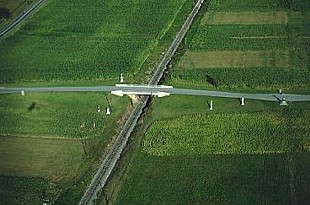
North of the McPherson Farm and the Chambersburg Pike lay an excavated railroad bed, complete except for the placement of stone, ties and rails.
The bed ran west from Gettysburg and cut through Seminary and McPherson's Ridges, and proved to be both a helpful and hazardous obstacle for both sides. After the opening infantry shots were fired
on the McPherson Farm, Brig. General Lysander Cutler's brigade moved north of the railroad bed where they were engaged by
Brig. General Joseph R. Davis' brigade of Mississippi and North Carolina regiments. Cutler's men were flanked and forced to retreat to Seminary Ridge. One regiment, the 147th New York Infantry, was nearly annihilated when the regimental officers did not receive the order
to retreat until it was too late and the Mississippians pounced upon them in overwhelming numbers. Driving back Cutler's men,
Davis turned his regiments southward to attack the Union units around the McPherson Farm. One lone regiment, the 6th Wisconsin
Infantry, blocked their way.
| Lt. Col. Rufus Dawes |
|
| Wi. Hist. Soc. |
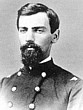
Commanded by Lieutenant Colonel Rufus R. Dawes, the 6th Wisconsin had been detached from the Iron Brigade as a reserve and seeing the retreat of Cutler's troops, Dawes had moved his regiment to the Chambersburg Pike where they
rested behind a solid rail fence that lined the road. The opponents immediately opened fire as the southerners crossed over
the railroad bed. Colonel Dawes recalled: "The regiment halted at the fence along the Cashtown Turnpike, and I gave the order
to fire. In the field, beyond the turnpike, a long line of yelling Confederates could be seen running forward and firing and
our troops of Cutler's brigade were running back in disorder. The fire of our carefully aimed muskets, resting on the fence
rails, striking their flank, soon checked the rebels in their headlong pursuit. The rebel line swayed and bent, and suddenly
stopped firing and the men ran into the railroad cut. I ordered my men to climb the over the turnpike fences and advance."
| The deep portion of the railroad cut |
|
| Gettysburg NMP |
The 95th New York Infantry arrived and moved adjacent to the 6th Wisconsin as the men clambered over the
fences. Colonel Dawes approached Major Edward Pye, commanding the New Yorkers: "I said, 'We must charge.' The gallant major
replied, 'Charge it is.' 'Forward, charge!' was the order I gave, and Major Pye gave the same command. We were receiving a
fearfully destructive fire from the hidden enemy. Men who had been shot were leaving the ranks in crowds. With the colors
at the advance point, the regiment firmly and hurriedly moved forward." The two regiments charged across 400 yards of open
field toward the blazing railroad bed, filled with soldiers of Davis' Brigade. The 2nd
and 42nd Mississippi regiments and 55th North Carolina were intermingled in the confusion, but turned their rifles toward
the Union troops with deadly accuracy. Colonel Dawes could only shout encouragement to his men: "The only commands I gave
as we advanced were, 'Align on the colors! Close up on the colors! Close up on the colors!' The regiment was being so broken
up that this order alone could hold the body together. The colors fell upon the ground several times but were raised again
by the heroes of the color guard. Four hundred and twenty men started in the regiment from the turnpike fence, of whom about
two hundred and forty reached the railroad cut."
As Dawes' dwindling ranks closed in on the southern line, many Confederates
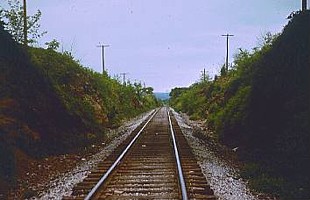
turned and ran into the deep portion of the cut through McPherson's Ridge. Others retreated across the field from which they
had driven Cutler's men only minutes before, while the majority of the 2nd Mississippi held their ground near their flag.
Sergeant William B. Murphy, the flag bearer of the 2nd Mississippi Infantry, stood near the railroad bed: "I did all that
was in my power to prevail upon the boys to come on and take the battery, not knowing at the time that we were overpowered
by those regiments of the enemy in our front, right, and left. Just about that time a squad of soldiers made a rush for my
colors and our men did their duty. They were all killed or wounded, but they still rushed for the colors with one of the most
deadly struggles that was ever witnessed during any battle in the war. Over a dozen men fell killed or wounded, and then a
large man made a rush for me and the flag. As I tore the flag from the staff he took hold of me and the color. The firing
was still going on, and was kept up for several minutes after the flag was taken from me." The large soldier was Corporal
Francis A. Waller, who wrestled Murphy and his flag to the ground, and then continued to fight those Confederates who refused
to give up. Waller would later receive a promotion to sergeant and the Congressional Medal of Honor for the capture of the
2nd Mississippi's flag.
| Surrender of Davis' soldiers in the railroad cut |
|
| National Archives |
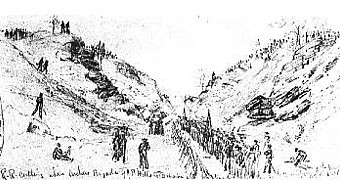
Just west of the melee around the Confederate colors, Colonel Dawes heard
his soldiers at the brink of the cut shouting to the southerners, "'Throw down your muskets! Down with your muskets!' Running
forward through our line of men, I found myself face to face with hundreds of rebels, whom I looked upon in the railroad cut,
which was, where I stood, four feet deep. I shouted, 'Where is the colonel of this regiment?' An officer in gray, with stars
on his collar, who stood among the men in the cut said, 'Who are you?' I said, 'I command this regiment. Surrender, or I will
fire.' The officer replied not a word, but promptly handed me his sword and his men, who still held them, threw down their
muskets. The coolness, self-possession, and discipline which held back our men from pouring in a general volley saved a hundred
lives of the enemy, and as my mind goes back to the fearful excitement of the moment, I marvel at it."
Joined in the charge by the 14th Brooklyn, the Union regiments rounded up
their captives and marched back to Seminary Ridge over a field strewn with the dead and wounded of both sides. The bloody
contest at the railroad cut "was a critical one, involving the defeat, perhaps the utter rout of our forces," as General Doubleday
reported. The crucial charge prevented the loss of the McPherson Farm positions which would play an important role in the
Union defense that afternoon. The shattered remnants of General Davis' brigade were taken out of the battle for the remainder
of the day, but would fight again on July 3. The loss was especially heavy in the 2nd Mississippi- one soldier wrote that
only 60 men could be mustered that evening. The 6th Wisconsin Infantry remained in the battle through the afternoon until
forced to retire with the remainder of the corps through Gettysburg.
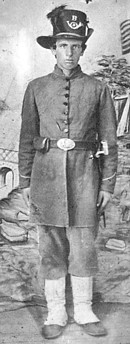
"Those damned black hats!"
| 6th Wisconsin Soldier |
|
| Gettysburg NMP |
Soldiers of the 6th Wisconsin
Infantry wore the regulation headgear of the United States Army, a stiff, broad-brimmed
hat made of black felt that was originally meant to be worn on formal occasions. General John Gibbon, the first commander
of the brigade to which the 6th belonged, preferred the appearance of the regulation hat accompanied by the skirted dress
coat, and ordered his Wisconsin
and Indiana regiments to wear it in place of the cloth forage
cap. Their appearance soon earned Gibbon's command the title of "The Black Hat Brigade" and the westerners appreciated how
it was their headgear that set them apart from other Union regiments in the Army of the Potomac. Even after General
Gibbon left the brigade and the more comfortable blouse was worn in lieu of the dress coat, the regulation dress hat remained
and was worn with great pride as the brigade symbol. It was soon after the Battle of South Mountain during the Antietam Campaign
when the more lasting nickname "Iron Brigade" was first coined by General Joe Hooker. Yet, Gettysburg would be the battle that would truly test their mettle. The Iron Brigade mustered
1,883 members on July 1, of which 1,212 soldiers were casualties before nightfall.
The young soldier shown here is Private Charles A. Keeler of St. Joseph, Michigan, who served in
Company B, 6th Wisconsin Infantry. He wears the Union dress coat and dress hat, fully adorned with brass numerals and black
ostrich feather. Private Keeler fought at Gettysburg and was
terribly wounded in both legs during the battle. (Image courtesy Alan Nolan, The Iron Brigade,
A Military History, State Historical Society of WI, 1975.)
Source: National Park Service; Gettysburg National Military Park
Recommended Reading: Gettysburg--The First Day,
by Harry W. Pfanz (Civil War America)
(Hardcover). Description: Though a great deal has been
written about the battle of Gettysburg, much of it has focused
on the events of the second and third days. With this book, the first day's fighting finally receives its due. Harry Pfanz,
a former historian at Gettysburg National
Military Park and author of
two previous books on the battle, presents a deeply researched, definitive account of the events of July 1, 1863. Continued below…
After sketching the background
of the Gettysburg
campaign and recounting the events immediately preceding the battle, Pfanz offers a detailed tactical description of the first
day's fighting. He describes the engagements in McPherson Woods, at the Railroad Cuts, on Oak
Ridge, on Seminary Ridge, and at Blocher's Knoll, as well as the retreat of Union forces through Gettysburg and the Federal rally on Cemetery Hill. Throughout, he draws on
deep research in published and archival sources to challenge some of the common assumptions about the battle--for example,
that Richard Ewell's failure to press an attack against Union troops at Cemetery Hill late on the first day ultimately cost
the Confederacy the battle.
Recommended Reading: Lost Triumph: Lee's Real Plan at Gettysburg--And Why It Failed.
Description: A fascinating narrative-and a bold new
thesis in the study of the Civil War-that suggests Robert E. Lee had a heretofore undiscovered strategy at Gettysburg that,
if successful, could have crushed the Union forces and changed the outcome of the war. The Battle of Gettysburg is the pivotal
moment when the Union forces repelled perhaps America's greatest commander-the
brilliant Robert E. Lee, who had already thrashed a long line of Federal opponents-just as he was poised at the back door
of Washington, D.C. It is
the moment in which the fortunes of Lee, Lincoln, the Confederacy, and the Union
hung precariously in the balance. Conventional wisdom has held to date, almost without exception, that on the third day of
the battle, Lee made one profoundly wrong decision.
But how do
we reconcile Lee the high-risk warrior with Lee the general who launched "Pickett's Charge," employing only a fifth of his
total forces, across an open field, up a hill, against the heart of the Union defenses? Most history books have reported that
Lee just had one very bad day. But there is much more to the story, which Tom Carhart addresses for the first time. With meticulous detail and startling clarity, Carhart revisits the
historic battles Lee taught at West Point and believed were the essential lessons in the art of war-the victories of Napoleon
at Austerlitz, Frederick the Great at Leuthen, and Hannibal at Cannae-and reveals what they can tell us about Lee's real strategy.
What Carhart finds will thrill all students of history: Lee's plan for an electrifying rear assault by Jeb Stuart that, combined
with the frontal assault, could have broken the Union forces in half. Only in the final hours of the battle was the attack
reversed through the daring of an unproven young general-George Armstrong Custer. About the Author: Tom Carhart has been a lawyer and a historian for the Department of the
Army in Washington, D.C. He is a graduate of West Point, a decorated
Vietnam veteran, and has earned a Ph.D. in American and military history
from Princeton University.
He is the author of four books of military history and teaches at Mary Washington College near his home in the Washington, D.C. area.
Recommended Reading: The Maps of Gettysburg:
The Gettysburg Campaign, June 3 - July 13, 1863
(Hardcover). Description: More academic and photographic
accounts on the battle of Gettysburg exist than for all other
battles of the Civil War combined-and for good reason. The three-days of maneuver, attack, and counterattack consisted of
literally scores of encounters, from corps-size actions to small unit engagements. Despite all its coverage, Gettysburg remains one of the most complex and difficult to understand battles of the war.
Author Bradley Gottfried offers a unique approach to the study of this multifaceted engagement. The Maps of Gettysburg plows
new ground in the study of the campaign by breaking down the entire campaign in 140 detailed original maps. These cartographic
originals bore down to the regimental level, and offer Civil Warriors a unique and fascinating approach to studying the always
climactic battle of the war. Continued
below...
The Maps of
Gettysburg offers thirty "action-sections" comprising the entire campaign. These include the march to and from the battlefield,
and virtually every significant event in between. Gottfried's original maps further enrich each "action-section." Keyed to
each piece of cartography is detailed text that includes hundreds of soldiers' quotes that make the Gettysburg
story come alive. This presentation allows readers to easily and quickly find a map and text on virtually any portion of the
campaign, from the great cavalry clash at Brandy Station on June 9, to the last Confederate withdrawal of troops across the
Potomac River on July 15, 1863. Serious students of the battle will appreciate the extensive
and authoritative endnotes. They will also want to bring the book along on their trips to the battlefield… Perfect for
the easy chair or for stomping the hallowed ground of Gettysburg,
The Maps of Gettysburg promises to be a seminal work that belongs on the bookshelf of every serious and casual student of
the battle.
Recommended Reading: Gettysburg:
A Testing of Courage. Description: America's
Civil War raged for more than four years, but it is the three days of fighting in the
Pennsylvania countryside in July 1863 that continues to
fascinate, appall, and inspire new generations with its unparalleled saga of sacrifice and courage. From Chancellorsville,
where General Robert E. Lee launched his high-risk campaign into the North, to the Confederates' last daring and ultimately-doomed
act, forever known as Pickett's Charge, the battle of Gettysburg gave the Union army a victory that turned back the boldest
and perhaps greatest chance for a Southern nation. Continued below...
Now, acclaimed
historian Noah Andre Trudeau brings the most up-to-date research available to a brilliant, sweeping, and comprehensive history
of the battle of Gettysburg that sheds fresh light on virtually every aspect of it. Deftly balancing his own
narrative style with revealing firsthand accounts, Trudeau brings this engrossing human tale to life as never before.
Recommended Reading: The History Buff's Guide to Gettysburg
(Key People, Places, and Events) (Key People, Places, and Events). Description: While most history books are dry monologues of people, places, events and dates, The History Buff's Guide is ingeniously written and full of not only first-person accounts
but crafty prose. For example, in introducing the major commanders, the authors basically call Confederate Lt. Gen. Richard
S. Ewell a chicken literally. Continued below...
'Bald, bug-eyed,
beak-nosed Dick Stoddard Ewell had all the aesthetic charm of a flightless foul.' To balance things back out a few pages later,
they say federal Maj. Gen. George Gordon Meade looked like a 'brooding gargoyle with an intense cold stare, an image in perfect
step with his nature.' Although it's called a guide
to Gettysburg,
in my opinion, it's an authoritative guide to the Civil War. Any history buff or Civil War enthusiast or even that casual
reader should pick it up.
Recommended Reading: Hallowed Ground: A Walk at Gettysburg, by James M.
Mcpherson (Crown Journeys) (Hardcover). Review From Publishers Weekly: The country's most distinguished Civil War historian, a Pulitzer Prize winner (for Battle
Cry of Freedom) and professor at Princeton, offers this compact and incisive study of the
Battle of Gettysburg. In narrating "the largest battle ever fought in the Western Hemisphere,"
McPherson walks readers over its presently hallowed ground, with monuments numbering into the hundreds, many of which work
to structure the narrative. They range from the equestrian monument to Union general John Reynolds to Amos Humiston, a New
Yorker identified several months after the battle when family daguerreotypes found on his body were recognized by his widow.
Indeed, while McPherson does the expected fine job of narrating the battle, in a manner suitable for the almost complete tyro
in military history, he also skillfully hands out kudos and criticism each time he comes to a memorial. Continued below...
He praises
Joshua Chamberlain and the 20th Maine, but also the 140th New York
and its colonel, who died leading his regiment on the other Union flank in an equally desperate action. The cover is effective
and moving: the quiet clean battlefield park above, the strewn bodies below. The author's knack for knocking myths on the
head without jargon or insult is on display throughout: he gently points out that North Carolinians think that their General
Pettigrew ought to share credit for Pickett's charge; that General Lee's possible illness is no excuse for the butchery that
charge led to; that African-Americans were left out of the veterans' reunions; and that the kidnapping of African-Americans
by the Confederates has been excised from most history books.
Recommended Reading: Gettysburg, by Stephen
W. Sears (640 pages) (November 3, 2004). Description: Sears
delivers another masterpiece with this comprehensive study of America’s most studied Civil War battle. Beginning with Lee's meeting with
Davis in May 1863, where he argued in favor of marching north, to take pressure off both Vicksburg and Confederate logistics. It ends with the battered Army
of Northern Virginia re-crossing the Potomac just two months later and with Meade unwilling to drive his equally battered
Army of the Potomac into a desperate pursuit. In between is the balanced, clear and detailed
story of how tens-of-thousands of men became casualties, and how Confederate independence on that battlefield was put forever
out of reach. The author is fair and balanced. Continued below...
He discusses
the shortcomings of Dan Sickles, who advanced against orders on the second day; Oliver Howard, whose Corps broke and was routed
on the first day; and Richard Ewell, who decided not to take Culp's Hill on the first night, when that might have been decisive.
Sears also makes a strong argument that Lee was not fully in control of his army on the march or in the battle, a view conceived
in his gripping narrative of Pickett's Charge, which makes many aspects of that nightmare much clearer than previous studies.
A must have for the Civil War buff and anyone remotely interested in American history.
|

